Category: Obadele Kambon Lectures

Category for the exclusive lectures by Ɔbenfo (Professor) Ọbádélé Bakari Kambon, PhD. “Ɔbenfo” Ọbádélé Bakari Kambon, Nana Kwame Pɛbi Datɛ I, helps Black people repatriate and get Ghanaian citizenship at RepatriateToGhana.com. He is a world-renowned master linguist, multi-award-winning scholar and the architect of Abibitumi the oldest and largest Black social education network on the planet. He completed his PhD in Linguistics at the University of Ghana in 2012, winning the prestigious Vice-Chancellor’s award for the Best PhD Thesis in the Humanities. He also won the 2016 and 2024 Provost’s Publications Awards for best published work in the UG College of Humanities. In 2019 he was the recipient of the [Nana] Marcus Mosiah Garvey Foundation award for excellence in Afrikan Studies and Education. Ɔbenfo Ọbádélé Kambon was awarded the 2020/2021 University of Lagos (UNILAG) Lagos Area Cluster Centre (LACC) Fellowship where he contributed significantly to the work of “reconfiguring” Afrikan Studies. In 2025, he was awarded the Kwame Nkrumah Award for Pan-African Leadership by the Pan-African Leadership Institute (PALI). He is an Associate Professor and served as Head of the Language, Literature and Drama Section of the Institute of African Studies at the University of Ghana and also served as Editor-in-Chief of the Ghana Journal of Linguistics (2016-2023). He served as Secretary of the African Studies Association of Africa from 2015-2020. He also played an instrumental role in 34 Abibifo ‘Black People’ of the Diaspora receiving Ghanaian citizenship in 2016 and many more receiving citizenship in 2019, 2022, and 2024. Having contributed to the Government of Ghana’s official Diaspora Engagement Policy, he now assists others interested in repatriation via RepatriateToGhana.com‘s Decade of Our Repatriation (DOOR Initiative), which has been endorsed by the Government of Ghana (Diaspora Affairs, Office of the President and Ghana Tourism Development Company). His multidisciplinary research interests include Serial Verb Construction Nominalization, Historical Linguistics, sbAyt nt Kmt(yw) ‘Studies of Black People’, & Abibifahodie ‘Black Liberation’.

  • What Truly Afrikan-Centered Education Looks Like — And Why Most Fall Short

    What Truly Afrikan-Centered Education Looks Like — And Why Most Fall Short

    Afrikan-centered education

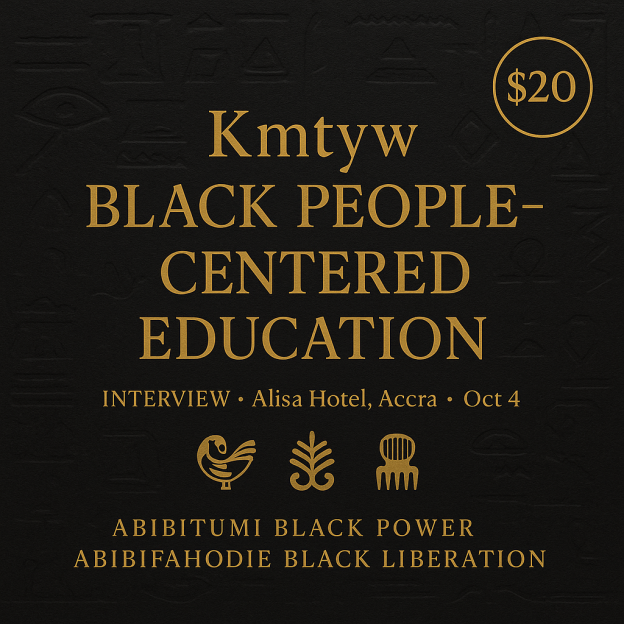
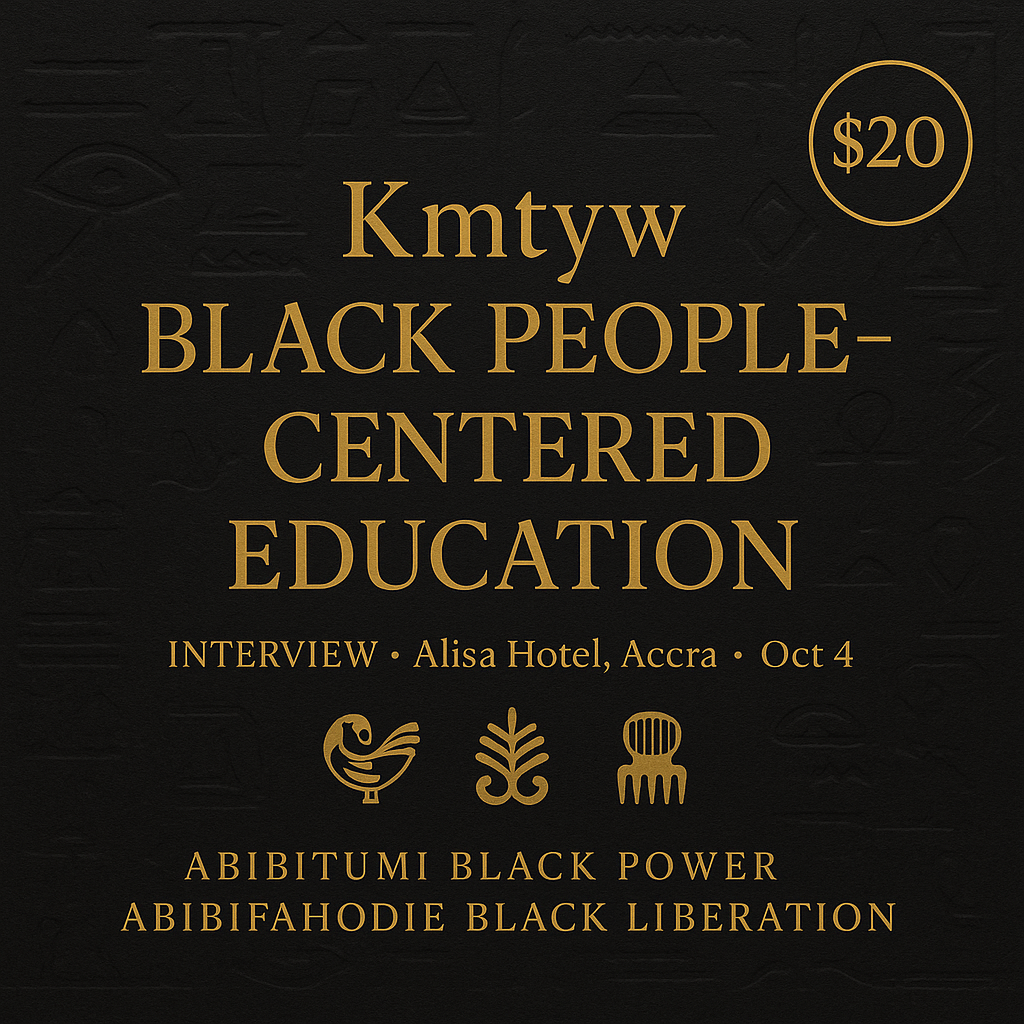
    Afrikan-centered education means nothing if it still orbits the oppressor’s world. Too many programs carry the name but operate on the periphery. They reference Afrikan history without centering Kmtyw people in practice. They use the language of liberation while delivering instruction in colonial tongues. As a result, our children learn about themselves without ever learning from themselves. That gap is not accidental. Furthermore, it is not harmless.

    Ɔbenfo Kambon Defines What Afrikan-Centered Education Must Actually Do

    Recorded live at the Alisa Hotel in Accra, this essential lecture features Ɔbenfo (Professor) Ọbádélé Bakari Kambon drawing a sharp line between appearance and substance. He establishes that true Kmtyw-centered education requires three things. First, knowledge of self. Second, knowledge of enemy. Third, and most importantly, the operationalization of both. However, most so-called models stop at the first. They celebrate identity without building power. Ɔbenfo Kambon refuses that limitation.

    In addition, he makes a decisive case for language. Instruction in Twi, Yorùbá, Wolof, Kikongo, and our other Afrikan languages is not a preference. It is a prerequisite. Our words shape our world. Therefore, when we teach our children in the colonizer’s language, we hand them a colonized mind. Abibitumi — Black Power — demands that our mediums of instruction align with our liberation goals. Abibifahodie is not an idea we discuss. It is a direction we move in, every day, through every choice.

    This lecture cuts through the comfortable performances that pass for progress. Ɔbenfo Kambon challenges educators, parents, scholars, and community builders to examine what they are actually centering. Is it Kmtyw people — or is it the approval of those who benefit from our confusion? Moreover, he provides a framework that moves from theory into daily practice. This is not abstract. This is the work. For every Afrikan person building toward genuine liberation, this recording belongs in your collection. Watch it, study it, and apply it.

    Watch / Get it here: So-Called “Afrikan-Centered” Education — Ɔbenfo Kambon | Abibitumi

  • Is Your Afrikan Spirituality Liberating You — Or Keeping You Enslaved?

    Is Your Afrikan Spirituality Liberating You — Or Keeping You Enslaved?

    Afrikan spirituality liberation

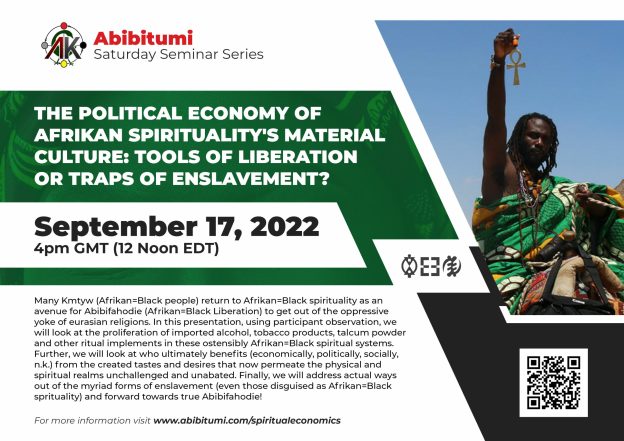
    Afrikan spirituality liberation calls many Kmtyw home — away from eurasian religions and back toward the sacred traditions of our ancestors. However, not everything labeled “Afrikan” actually serves Afrikan people. In fact, some of it serves our oppressors directly. This critical truth sits at the heart of one of Ɔbenfo Ọbádélé Bakari Kambon’s most important presentations available now through Abibitumi.

    In this powerful lecture, Ɔbenfo Kambon applies participant observation to examine what fills the altars and ritual spaces of ostensibly Afrikan spiritual systems. Furthermore, he identifies a troubling pattern: imported alcohol, tobacco, talcum powder, and other commodities dominate these sacred spaces. As a result, someone is profiting — and that someone is not us. Ɔbenfo asks the essential question directly: who ultimately benefits economically, politically, and socially from the tastes and desires now embedded in our spiritual practice?

    Unmasking the Political Economy Hidden Inside Afrikan Spirituality Liberation

    Most importantly, this lecture does not stop at critique. Ɔbenfo Kambon charts a clear and actionable path forward. He distinguishes between spiritual systems that genuinely advance Abibifahodie and those that quietly extend our enslavement under a different name. In addition, he equips Kmtyw with the analytical tools to see these distinctions clearly. Therefore, this is not simply an academic exercise — it is a roadmap for our collective liberation.

    This lecture is essential for scholars, community builders, students, and every Afrikan person seriously committed to Abibifahodie. Moreover, it pairs a full video recording with slides, giving you both the depth of Ɔbenfo’s analysis and the visual framework to study and share it. Abibitumi continues to deliver the knowledge our communities need — uncompromised and unapologetic. Watch it, study it, and act on it.

    🎥 Watch / Get it here: The Political Economy of Afrikan Spirituality’s Material Culture — $20.00

  • Afrika Knew No Divide: When Science and Humanity Were One

    Afrika Knew No Divide: When Science and Humanity Were One

    Afrikan science and humanities

    Afrikan science and humanities were never two different things — they were always one. Modern academia invented that split. Ancient Afrika did not recognize it. In this powerful 2014 lecture delivered at the NYU/IAS Conference on the Humanities, Ɔbenfo Ọbádélé Bakari Kambon dismantles that false division with precision and evidence. Furthermore, he does it in just 13 minutes and 25 seconds.

    How Ɔbenfo Kambon Reconnects Afrikan Science and Humanities Across 13,000 Years

    Ɔbenfo Kambon walks us through 13,000 years of Afrikan intellectual history. He shows clearly that the Kmtyw used geometric principles, mathematics, and engineering as expressions of philosophy, spirit, and culture. In addition, he demonstrates that STEM and the humanities were not competing fields in ancient Afrika. Most importantly, they were complementary forces within a unified Afrikan worldview. This lecture challenges every colonial framework still operating inside our institutions today.

    The presentation includes 67 slides packed with evidence, analysis, and visual support. Ɔbenfo covers languages, literature, philosophy, religion, archaeology, linguistics, semiotics, and more. He shows how each of these areas flows naturally from a single Afrikan root. As a result, this is not just an academic lecture — it is a blueprint for how we must rebuild Afrikan education. Abibifahodie demands that we reclaim how we define, organize, and transmit knowledge.

    This is exactly the kind of content Abibitumi was built to preserve and deliver. However, this lecture is not just for scholars. Parents, students, and community builders all need this foundation. When we understand that our ancestors never fragmented knowledge the way colonizers do, we build stronger institutions. We raise children with whole minds. We stop apologizing for centering Afrika. Furthermore, we stop letting others define what counts as science, what counts as culture, and what counts as truth. The combo bundle includes the full video and a secured downloadable PDF of the PowerPoint — 67 slides of concentrated Afrikan intellectual power.

    Watch the lecture and download the full presentation here for just $20:
    👉 13,000 Years in 13 Minutes — Watch / Get It Here

  • Who Are You, Really? The Kmtyw Understanding of the Person as Multiple Selves

    Who Are You, Really? The Kmtyw Understanding of the Person as Multiple Selves

    Kmtyw concepts of the person

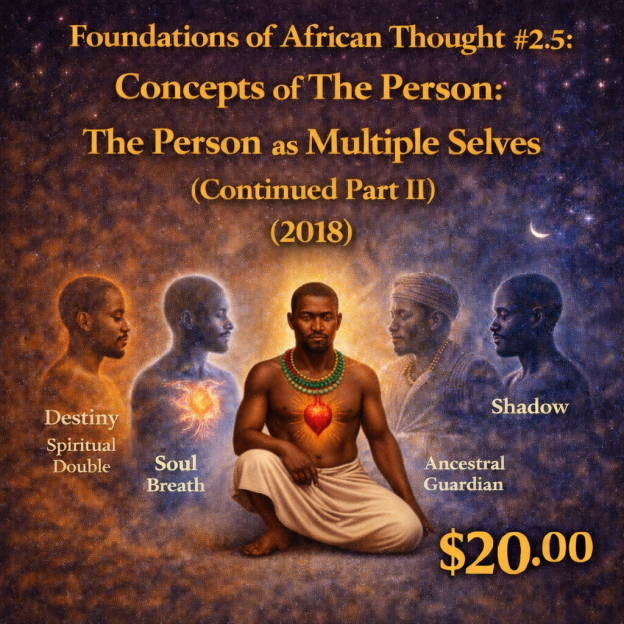
    Kmtyw concepts of the person challenge everything the Western world has told us about who we are. For centuries, colonial thought reduced human beings to isolated individuals — biological units with no deeper cosmological identity. However, our Afrikan ancestors understood something far more profound. The person is not a single, fixed self. Instead, the person is a dynamic, relational, and multi-dimensional being — fully embedded in the cosmos, the community, and the moral order of Ma’at.

    In this essential lecture, Ɔbenfo Ọbádélé Bakari Kambon — linguist, Pan-Afrikan scholar, and architect of Abibitumi — guides us through the classical intellectual traditions of Kmt. Drawing on both continental and diasporan sources, he dismantles the atomized view of personhood completely. Furthermore, he demonstrates how each dimension of the self carries its own ontological, moral, and cosmological function. This is not abstract philosophy. Most importantly, this is a framework for liberation — for understanding ourselves as Kmtyw people on our own terms.

    Why Kmtyw Concepts of the Person Matter for Abibifahodie

    Liberation begins in the mind. Therefore, reclaiming how we define ourselves is one of the most revolutionary acts we can perform. This session — Week 2.5 of the Foundations of Kmtyw Thought series — runs nearly four hours and includes 69 slides in a secured PDF. It covers the person as a composite being, with multiple interdependent selves operating simultaneously. In addition, Ɔbenfo situates all of this within a cosmological framework that honors the depth and genius of Afrikan thought. This is exactly the kind of knowledge that schools will never teach our children.

    As a result, this lecture is essential for scholars, students, parents, and community builders across the Afrikan world. Whether you are new to Kmtyw studies or deepening an existing foundation, this session will sharpen your understanding profoundly. It will also strengthen your ability to pass this knowledge to the next generation. This is the work of Abibitumi — building a liberated Afrikan mind, one lesson at a time. Do not wait to access this knowledge.

    Watch / Get it here: Foundations of Kmtyw Thought #2.5 — The Person as Multiple Selves

  • What Makes Black People Black? Ɔbenfo Kambon Breaks Down Afrikan Identity and White Supremacy

    What Makes Black People Black? Ɔbenfo Kambon Breaks Down Afrikan Identity and White Supremacy

    what makes Black people Black

    Understanding what makes Black people Black is one of the most liberating questions Afrikan people can study. Too often, we accept definitions handed to us by systems designed to erase us. However, Ɔbenfo Ọbádélé Bakari Kambon — world-renowned Pan-Afrikan linguist and architect of Abibitumi — refuses that erasure. In this essential lecture, he goes to the root. He dissects Afrikan identity with precision, love, and revolutionary clarity.

    What Makes Black People Black — and What Makes Krakkkaz Krakkk

    This presentation does not stop at identity affirmation. Furthermore, it names and analyzes the system working against us. Ɔbenfo Kambon examines the biological, cultural, and ideological forces that define Blackness on our own terms. In addition, he exposes the mechanisms that sustain white supremacist behavior and thinking. As a result, viewers leave with sharper tools for understanding the world — and their place of power within it. This is Abibifahodie scholarship in action.

    Most importantly, this lecture comes with downloadable presentation slides. Therefore, students, educators, and community builders can study, teach, and share this knowledge beyond the screen. The slides make this resource ideal for study circles, classrooms, and organizational development sessions. Abibitumi was built to put transformative Afrikan knowledge directly into Black hands. This lecture delivers exactly that. Every frame challenges anti-Black miseducation at its foundation.

    What makes Black people Black is not a question of confusion — it is a question of reclamation. Moreover, this lecture gives our community the language, evidence, and ancestral grounding to answer it with confidence. The Kmtyw and all Afrikan people deserve scholarship that builds rather than begs. Ɔbenfo Kambon’s work does precisely that. Do not miss this opportunity to strengthen your ideological foundation. Watch the lecture and download the slides today.

    Watch / Get it here: Ɔbenfo Obadele Kambon — What Makes Black People Black ($20.00)