Category: Obadele Kambon Lectures

Category for the exclusive lectures by Ɔbenfo (Professor) Ọbádélé Bakari Kambon, PhD. “Ɔbenfo” Ọbádélé Bakari Kambon, Nana Kwame Pɛbi Datɛ I, helps Black people repatriate and get Ghanaian citizenship at RepatriateToGhana.com. He is a world-renowned master linguist, multi-award-winning scholar and the architect of Abibitumi the oldest and largest Black social education network on the planet. He completed his PhD in Linguistics at the University of Ghana in 2012, winning the prestigious Vice-Chancellor’s award for the Best PhD Thesis in the Humanities. He also won the 2016 and 2024 Provost’s Publications Awards for best published work in the UG College of Humanities. In 2019 he was the recipient of the [Nana] Marcus Mosiah Garvey Foundation award for excellence in Afrikan Studies and Education. Ɔbenfo Ọbádélé Kambon was awarded the 2020/2021 University of Lagos (UNILAG) Lagos Area Cluster Centre (LACC) Fellowship where he contributed significantly to the work of “reconfiguring” Afrikan Studies. In 2025, he was awarded the Kwame Nkrumah Award for Pan-African Leadership by the Pan-African Leadership Institute (PALI). He is an Associate Professor and served as Head of the Language, Literature and Drama Section of the Institute of African Studies at the University of Ghana and also served as Editor-in-Chief of the Ghana Journal of Linguistics (2016-2023). He served as Secretary of the African Studies Association of Africa from 2015-2020. He also played an instrumental role in 34 Abibifo ‘Black People’ of the Diaspora receiving Ghanaian citizenship in 2016 and many more receiving citizenship in 2019, 2022, and 2024. Having contributed to the Government of Ghana’s official Diaspora Engagement Policy, he now assists others interested in repatriation via RepatriateToGhana.com‘s Decade of Our Repatriation (DOOR Initiative), which has been endorsed by the Government of Ghana (Diaspora Affairs, Office of the President and Ghana Tourism Development Company). His multidisciplinary research interests include Serial Verb Construction Nominalization, Historical Linguistics, sbAyt nt Kmt(yw) ‘Studies of Black People’, & Abibifahodie ‘Black Liberation’.

  • Afrikan Martial Science Reclaimed: Kmtyw Thought in Combat and Military Strategy

    Afrikan Martial Science Reclaimed: Kmtyw Thought in Combat and Military Strategy

    Afrikan martial science

    Afrikan martial science is not a footnote in history — it is a living, breathing system of knowledge that sustained our people through centuries of resistance. In this powerful Week 11 installment of the Foundations of Kmtyw Thought series, Ɔbenfo Ọbádélé Bakari Kambon delivers nearly three hours of rigorous, unapologetic scholarship. He illuminates the deep roots of Afrikan combat traditions across the continent and throughout the diaspora. This is not watered-down academic theory. This is Abibifahodie in practice.

    How Kmtyw Thought Transforms Our Understanding of Afrikan Martial Science

    Ɔbenfo Kambon grounds this lecture in essential scholarly texts. He draws directly from T. J. Desch-Obi’s Fighting for Honor, which traces Afrikan martial art traditions across the Atlantic World. Furthermore, he engages F. B. Aboagye’s critical work on indigenous Afrikan warfare in the Gold Coast, Asante, and the Northern Territories. Together, these readings build an iron foundation. They reveal that our ancestors developed sophisticated, strategic, and spiritually grounded systems of combat. In addition, this lecture connects those ancestral systems to Afrikan resistance movements in the diaspora. The result is a full, powerful picture of Kmtyw military intelligence.

    This lecture comes as a Video + Secured PDF combo. The PDF includes 53 slides of carefully organized content. However, the real power lives in watching Ɔbenfo Kambon teach. He synthesizes historical analysis, linguistic precision, and Pan-Afrikan vision into every minute of this 2-hour, 52-minute session. Most importantly, he teaches in a way that activates — not just informs. Every Afrikan scholar, student, parent, and community builder needs this knowledge. Abibitumi exists precisely to deliver this kind of transformative education directly to our people.

    Understanding Afrikan martial science is inseparable from understanding liberation itself. Our ancestors did not wait passively. They organized, trained, and fought with brilliance and purpose. As a result, their legacy demands that we study, preserve, and build upon their strategies today. This lecture is your entry point into that tradition. Moreover, it belongs in every study circle, classroom, and liberation curriculum across the Black world. Do not sleep on this resource. Watch it, study it, and share it with your community.

    Watch / Get it here: Foundations of Kmtyw Thought #11 — Afrikan Thought in Combat/Military Science | $20.00

  • Burkina Faso 2025: Ghana Delegation Prepares for a Historic Citizenship Journey

    Burkina Faso 2025: Ghana Delegation Prepares for a Historic Citizenship Journey

    Burkina Faso 2025 delegation

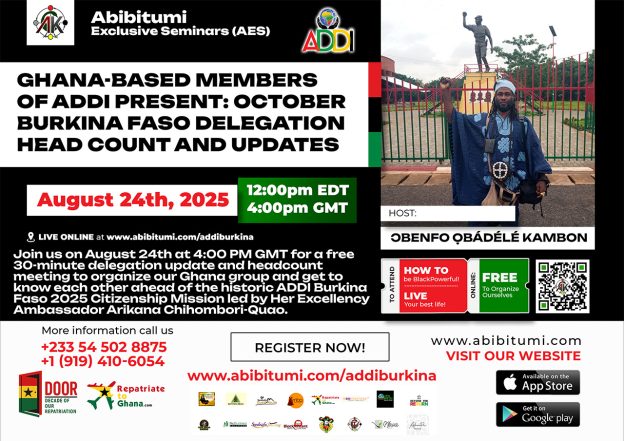
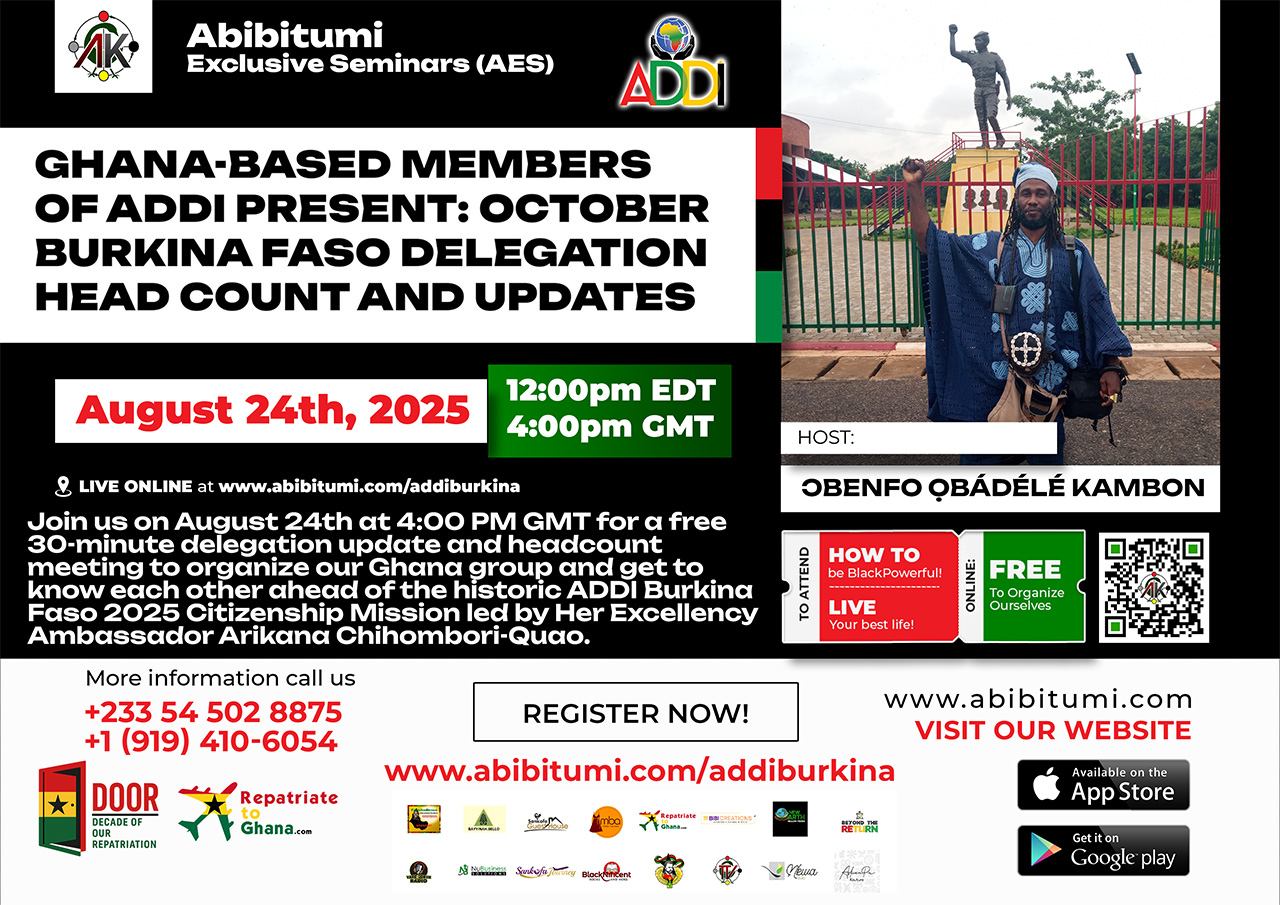
    The Burkina Faso 2025 delegation is gathering, organizing, and preparing for one of the most meaningful journeys in recent Pan-Afrikan history. On August 24th, 2025, from 4:00 to 4:30 PM GMT, Abibitumi hosts a free online update and headcount meeting for the Ghana chapter of this historic mission trip. Furthermore, this session is open to all who have answered the call to return, reconnect, and rebuild on Afrikan soil. Every seat in this meeting matters deeply.

    Abibifahodie — Black Liberation — is not merely a concept. It is a lived commitment. This delegation represents that commitment in action. Through the African Diaspora Direct Investment (ADDI) initiative, Afrikan people are actively reclaiming citizenship and planting roots in Burkina Faso. Moreover, this mission trip is part of a long tradition of Pan-Afrikan return that Abibitumi has championed for years. Ɔbenfo Ọbádélé Bakari Kambon, world-renowned linguist, scholar, and the architect of Abibitumi, has long emphasized that Afrikan people must move beyond symbolism into sovereign, practical action. This delegation embodies that teaching directly and powerfully.

    Why the Burkina Faso 2025 Delegation Demands Your Full Attention

    This is not a tourist trip. This is a strategic, community-led return to the Motherland. The Ghana delegation update meeting exists to ensure every participant is informed, connected, and ready. In addition, it gives delegation members the chance to align on logistics, ask critical questions, and build solidarity before departure. As a result, those who attend will move forward with clarity and confidence. Most importantly, this meeting is completely free. There is no barrier between you and preparation for this historic journey.

    Abibitumi continues to create spaces where Afrikan people worldwide take bold, collective steps toward liberation. However, action requires preparation. This short 30-minute session offers exactly that — a structured, focused, community-centered moment to get aligned. Therefore, whether you are a confirmed delegation member or still considering your path, this meeting will ground you in what comes next. The Burkina Faso 2025 delegation is moving forward with purpose. Join your people, show up fully, and be counted. Register now and secure your place in this historic mission.

    Watch / Get it here: https://stg-abibitumi-rpd-3fbq.ue1.rapydapps.cloud/product/addi-ghanas-burkina-faso-2025-delegation-update-headcount-meeting-free/

  • The Real Story of Black Liberation: Reclaiming Afrikan History Before 1619

    The Real Story of Black Liberation: Reclaiming Afrikan History Before 1619

    Afrikan history before 1619

    Afrikan history before 1619 is far richer, far more defiant, and far more liberating than the mainstream narrative ever acknowledges. Most people accept 1619 as the starting point of the Afrikan experience in the so-called Americas. However, that framing is a carefully constructed lie. In truth, Afrikan people were already resisting, rebelling, and building free communities on this soil nearly a century before that date.

    In 1526, enslaved Afrikans at San Miguel de Guadalupe — in what colonizers called Spanish Florida — launched a successful rebellion. They drove off the Spanish. They won their freedom. Furthermore, they became permanent settlers, establishing one of the first free Black communities in the western hemisphere. Similarly, throughout the 1500s and into the early 1600s, Afrikan people across the so-called new world emancipated themselves and built free republics. These were not footnotes. These were acts of sovereign power. In addition, the transatlantic trade itself began not in 1619 but in 1441 — a fact that exposes the 400-year framing as a deliberate misdirection.

    Ɔbenfo Kambon Breaks Down the Misorientation Rooted in Afrikan History Before 1619

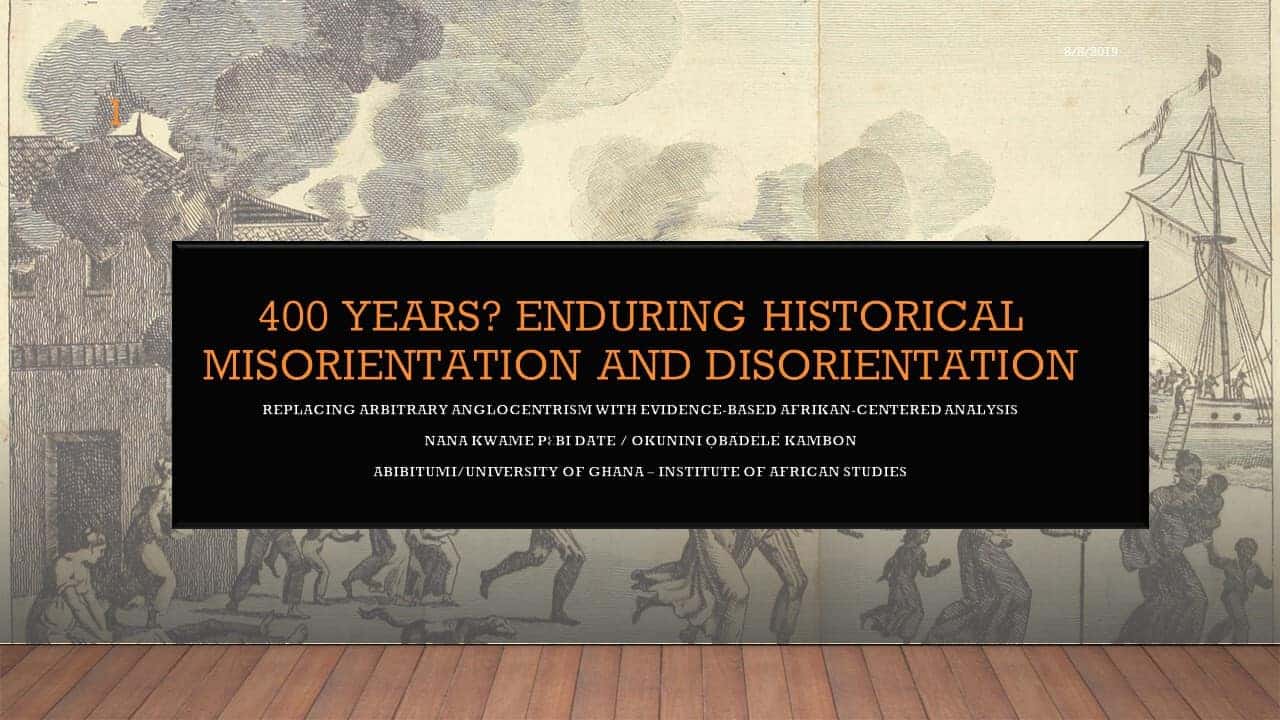
    Ɔbenfo Ọbádélé Bakari Kambon — Pan-Afrikan linguist, scholar, and architect of Abibitumi — delivers a masterful analysis of this historical misorientation in his lecture, 400 Years? Enduring Historical Misorientation and Disorientation and the Year of Return. He does not simply correct the record. Most importantly, he reveals why the misdirection exists and who benefits from it. He connects this distortion directly to the ongoing psychological and spiritual disorientation of Afrikan people worldwide. As a result, this lecture is not merely academic — it is a tool for Abibifahodie, Black Liberation itself.

    Abibitumi exists to provide Afrikan people with exactly this kind of weaponized knowledge. Therefore, this lecture belongs in every home, every classroom, every community circle committed to truth. Understanding our full history — unfiltered and unapologetic — is the foundation of liberation. Furthermore, when we know how far back our resistance goes, we reclaim our power. We reclaim our identity. We reclaim our future. Do not allow a single colonial date to define the magnitude of who we are and all that our ancestors accomplished. Watch this lecture. Study it. Share it.

    Watch / Get it here: 400 Years? Enduring Historical Misorientation and Disorientation and the Year of Return — $20.00

  • Ancient Kemetic Wisdom Meets Akan Song: Life Is a Journey Explored

    Ancient Kemetic Wisdom Meets Akan Song: Life Is a Journey Explored

    Kemetic wisdom Akan song

    Kemetic wisdom and Akan song converge powerfully in this essential lecture from Ɔbenfo Ọbádélé Bakari Kambon. In it, he illuminates a profound ancient teaching: pXrt pw anx — “life is a journey.” This is not metaphor alone. It is a living, documented truth rooted in the pXrt pw anx tradition and confirmed across Afrikan thought. Furthermore, a Twi proverb reinforces it directly: abɔdeɛ ne abrabɔ mu yɛ ntaa — nature and life are twins. These are not coincidences. They are evidence of one continuous Afrikan intellectual lineage.

    How Kemetic Wisdom and Akan Song Unlock a Unified Afrikan Worldview

    Ɔbenfo Ọbádélé Kambon draws on Akora Dua Kube’s song — documented by Agya Koo Nimo — to show a striking connection. The song traces an elder who walked the path of sacrifice for future generations. In addition, Faulkner’s 1956 translation of the Kemetic source text anchors the linguistic and philosophical bridge. Ɔbenfo demonstrates how the goat’s proverb — deɛ ɛbɛba aba dada, “what will come has already come” — echoes the sun’s eternal cycle. This is Afrikan cyclical cosmology. It breathes across millennia and across geography.

    Most importantly, Ɔbenfo connects Ahome song traditions to this same current of thought. He shows how oral tradition, sacred text, and musical expression carry one message across Afrikan communities. However, this is not passive observation. Ɔbenfo Ọbádélé Kambon frames all of this within Abibifahodie — Black Liberation. Understanding our cosmological unity is itself a liberatory act. As a result, this lecture does not just teach history. It equips Afrikan people with the consciousness to reclaim and rebuild.

    This lecture belongs in every Afrikan household, classroom, and community circle. Students, scholars, elders, and parents will all find grounding here. Furthermore, Abibitumi continues to make this quality of Afrikan-centered scholarship accessible to our people worldwide. The work Ɔbenfo Ọbádélé Kambon produces through Abibitumi is not performative. It is transformative. Therefore, do not sleep on this resource. Our ancestors spoke. Ɔbenfo translates their words into liberation tools for us today. Watch it, study it, and share it widely.

    Watch / Get it here: pXrt pw anx — Life Is a Journey | Abibitumi.com

  • How Akan Serial Verb Nominalization Reveals the Living Power of Afrikan Language

    How Akan Serial Verb Nominalization Reveals the Living Power of Afrikan Language

    Akan serial verb nominalization

    Akan serial verb nominalization is one of the most dynamic and generative forces in Afrikan linguistics today. It shows how language grows from the inside — organically, communally, and on its own terms. Furthermore, this is not a peripheral topic. It sits at the very heart of how Akan-speaking people create meaning, name new realities, and sustain cultural continuity across generations. Most importantly, understanding this process affirms that Afrikan languages are living, structured, and intellectually sovereign systems.

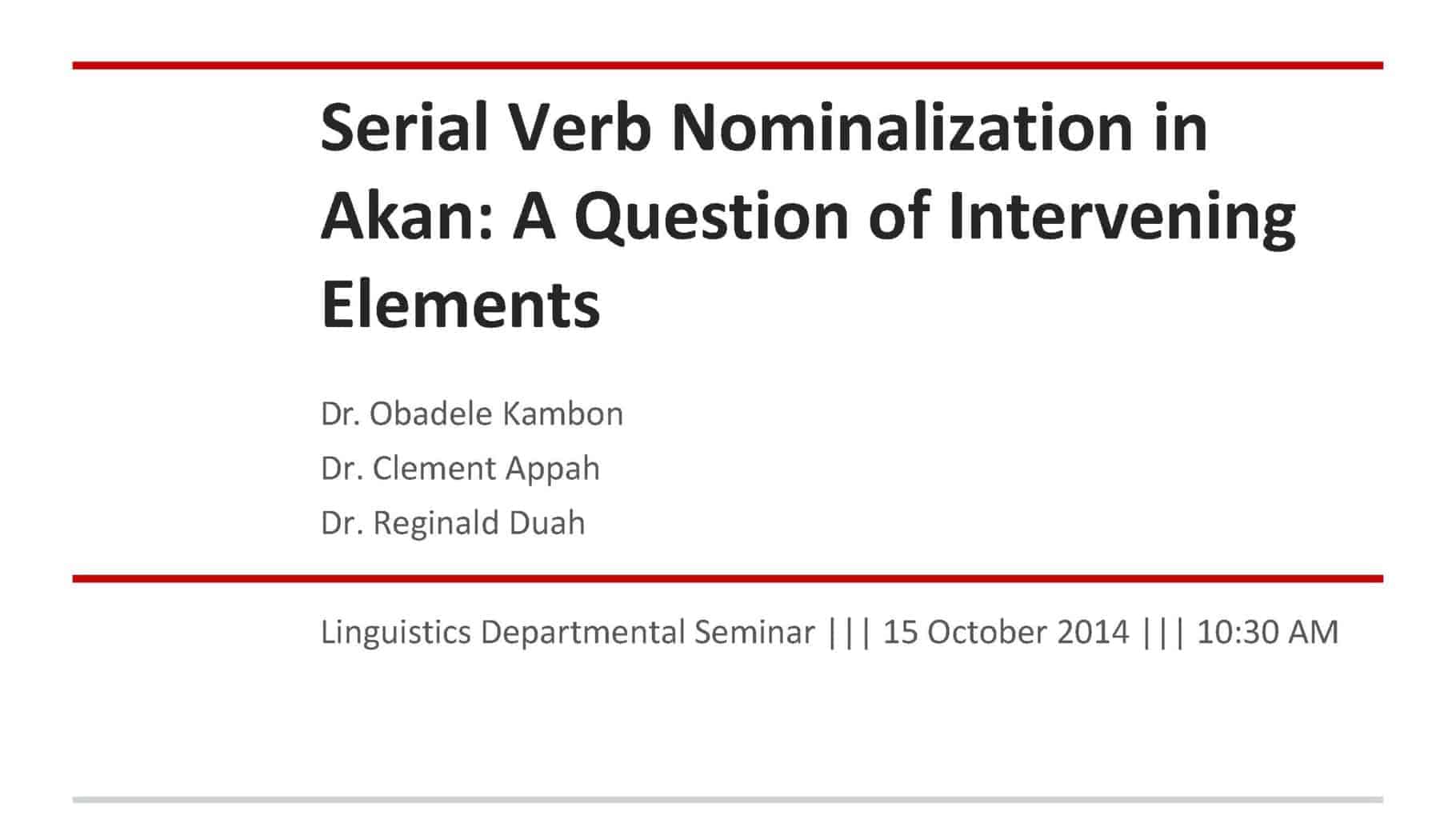
    In this lecture, Ɔbenfo Ọbádélé Bakari Kambon — joined by Dr. Clement Appah and Dr. Reginald Duah — presents a rigorous scholarly examination of how new nominal forms emerge in Akan. Ɔbenfo Kambon argues that novel forms follow morphosyntactic base templates. In other words, speakers do not form new words randomly. Instead, they apply structured patterns by analogy to meet the speech community’s evolving needs. As a result, the language expands without losing its internal logic or cultural grounding. This insight connects powerfully to Booij’s (2007) word formation schema theory — yet it centers Akan on its own linguistic foundations.

    Why Akan Serial Verb Nominalization Demands Our Full Scholarly Attention

    Afrikan languages have long been misrepresented in Western academic spaces. However, scholarship like this dismantles those distortions directly. This 54-minute lecture, available through Abibitumi.com, includes 34 downloadable PowerPoint slides for deeper study. Together, they provide a thorough and accessible resource for linguists, students, and community educators alike. In addition, the lecture raises critical questions about intervening elements — asking which morphosyntactic structures permit or block nominalization processes. These are not abstract puzzles. They reveal how Akan encodes thought, structures knowledge, and builds community language in real time.

    Abibitumi exists to place this quality of scholarship directly in the hands of Afrikan people worldwide. Every lecture we carry serves Abibifahodie — the liberation of Black people through knowledge, culture, and self-determination. This resource is no exception. Furthermore, whether you are a professional linguist, a parent teaching your children Akan, or a student building your intellectual foundation, this lecture speaks to you. Do not sleep on the tools your liberation requires. Watch the full lecture and download the slides today.

    Watch / Get it here: Serial Verb Nominalization in Akan — Video + PDF Bundle ($20.00)