Tag: Yoruba

  • Akan and Yoruba Share the Same Roots — Here’s the Linguistic Proof

    Akan and Yoruba Share the Same Roots — Here’s the Linguistic Proof

    Akan Yoruba sound correspondences

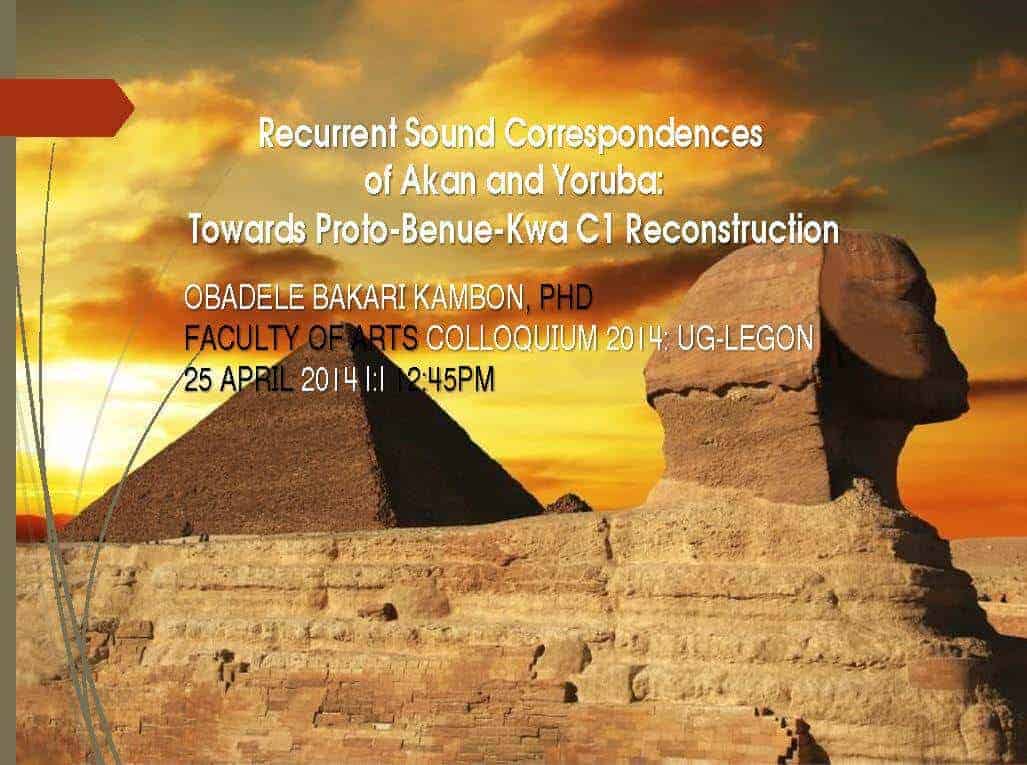
    Akan Yoruba sound correspondences are not coincidence — they are evidence of a shared Afrikan linguistic ancestry. Ɔbenfo Ọbádélé Bakari Kambon, world-renowned Pan-Afrikan linguist and architect of Abibitumi, brings this evidence into sharp focus. His groundbreaking presentation applies rigorous comparative linguistics to data drawn from the Swadesh Lists. As a result, Afrikan people gain a powerful, scholarly window into their own deep history.

    In this lecture, Ɔbenfo Kambon examines lexical cognates found in both Akan (Twi) and Yoruba. Furthermore, he applies implicational laws of sound change to reconstruct Proto-Benue-Kwa — the ancestral proto-language from which both languages descend. This work centers the initial consonant position, known as C1, as a key site of analysis. Most importantly, this is not abstract theory. This is Afrikan people reclaiming the record of their own linguistic and cultural continuity.

    Why Reconstructing Akan Yoruba Sound Correspondences Matters for Abibifahodie

    Language is power. Knowing how Afrikan languages connect across geography and time strengthens collective Afrikan identity. In addition, this research challenges Eurocentric frameworks that have long fragmented and misrepresented Afrikan linguistic heritage. Ɔbenfo Kambon’s methodology is precise, disciplined, and unapologetically centered on Afrikan people. His reconstruction of Proto-Benue-Kwa pushes comparative linguistics forward — and it does so on Afrikan terms. Scholars, students, and community builders alike will find this presentation both intellectually rigorous and deeply affirming.

    This video lecture includes the full presentation slides for deeper study and reference. However, this resource is not just for academics. Parents teaching their children Twi or Yoruba will find new meaning in the sounds they already speak. Community builders working toward Abibifahodie — Black Liberation — need exactly this kind of foundational knowledge. Abibitumi exists to make this scholarship accessible to all Afrikan people everywhere. Watch, study, and share this work widely.

    Watch / Get it here: Recurrent Sound Correspondences of Akan and Yoruba — Video + Presentation Slides | $20.00

  • One Afrikan Mind: Body Part Expressions Across Akan, Yorùbá, Kiswahili, and Mdw Ntr

    Afrikan language body expressions

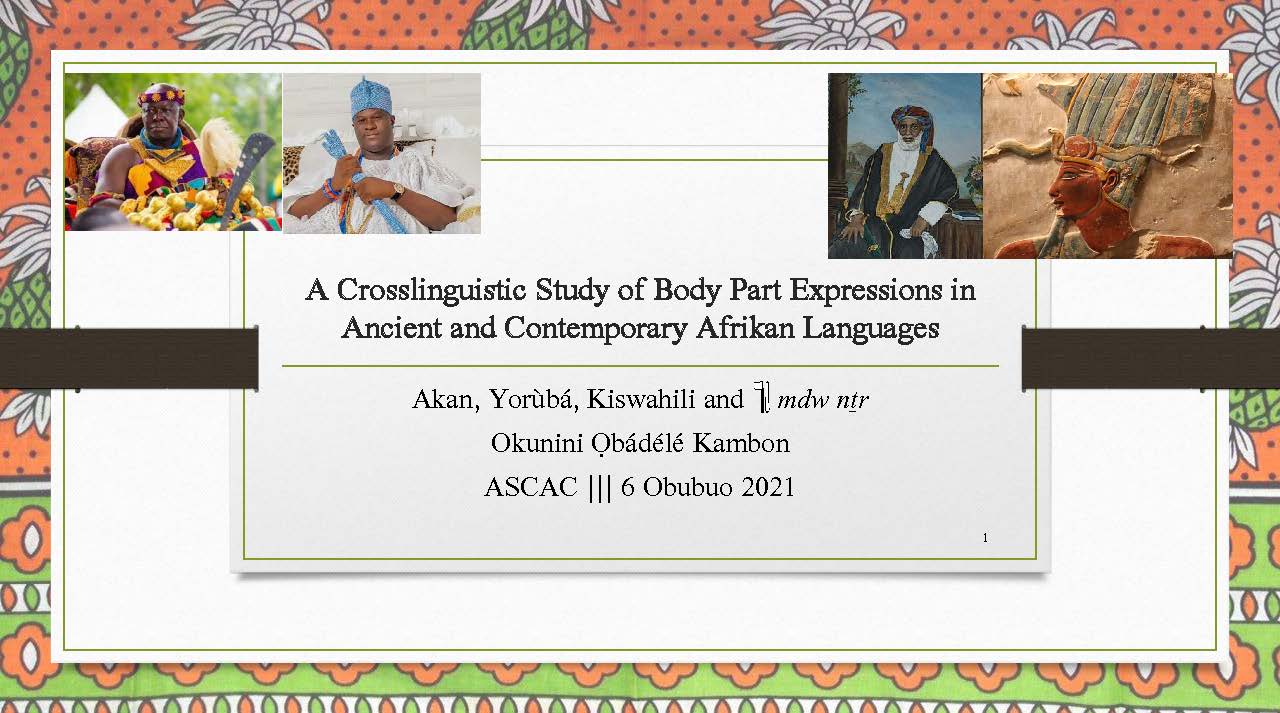
    Afrikan language body expressions carry a power that most academic institutions will never teach. They reveal something profound — that Afrikan people, across centuries and continents, share a continuous and unified worldview. In this landmark 2021 ASCAC presentation, Ɔbenfo Ọbádélé Bakari Kambon demonstrates exactly that. He traces linguistic patterns from Akan, Yorùbá, and Kiswahili all the way back to mdw nTr — the sacred language of the Kmtyw themselves.

    How Afrikan Language Body Expressions Reveal a Shared Continental Worldview

    Ɔbenfo Kambon examines how body parts function as conceptual anchors in four Afrikan languages. Furthermore, he shows that each language preserves a tight relationship between the physical body and its symbolic meaning. This is not coincidence. It is evidence of a shared philosophical inheritance — one that connects our ancestors in ancient Kmt to our communities in West and East Afrika today. In addition, the study draws from oral and written texts, grounding every insight in real, attested Afrikan expression.

    Most importantly, Ɔbenfo Kambon introduces a powerful analytical tool — the fundamental interrelation/fundamental alienation continuum. This framework measures how closely a language preserves its original, embodied Afrikan logic. As a result, we can chart which expressions stay rooted in Afrikan thought and which show signs of colonial disruption. This lens gives scholars, students, and community builders a sharper way to understand language as liberation — or as loss.

    This 33-minute lecture is essential viewing for anyone serious about Abibifahodie. It is precise, rigorous, and unapologetically Pan-Afrikan. Ɔbenfo Kambon does not simply compare languages — he reconstructs a worldview. He proves that the linguistic thread connecting Akan proverbs to Yorùbá idioms to Kiswahili expressions to mdw nTr hieroglyphics is unbroken. Abibitumi exists to bring exactly this kind of knowledge directly to Afrikan people everywhere. Watch this lecture, study it deeply, and share it widely.

    📺 Watch / Get it here: ASCAC 2021 — Body Part Expressions in Akan, Yorùbá, Kiswahili, and mdw nTr — Available now for $20.00.

  • Kamose Stelae Decoded: Afrikan Languages, Strategy & Black Liberation at ASCAC 2025

    Kamose Stelae Decoded: Afrikan Languages, Strategy & Black Liberation at ASCAC 2025

    Kamose Stelae Black liberation

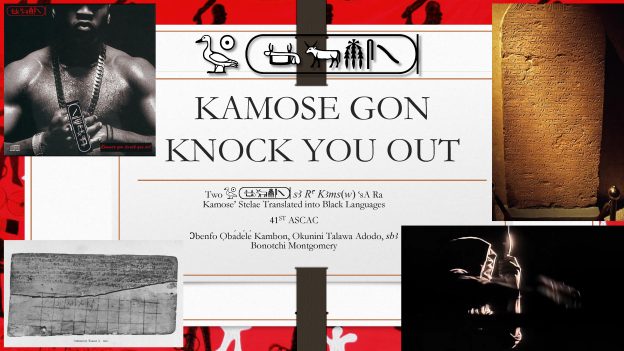
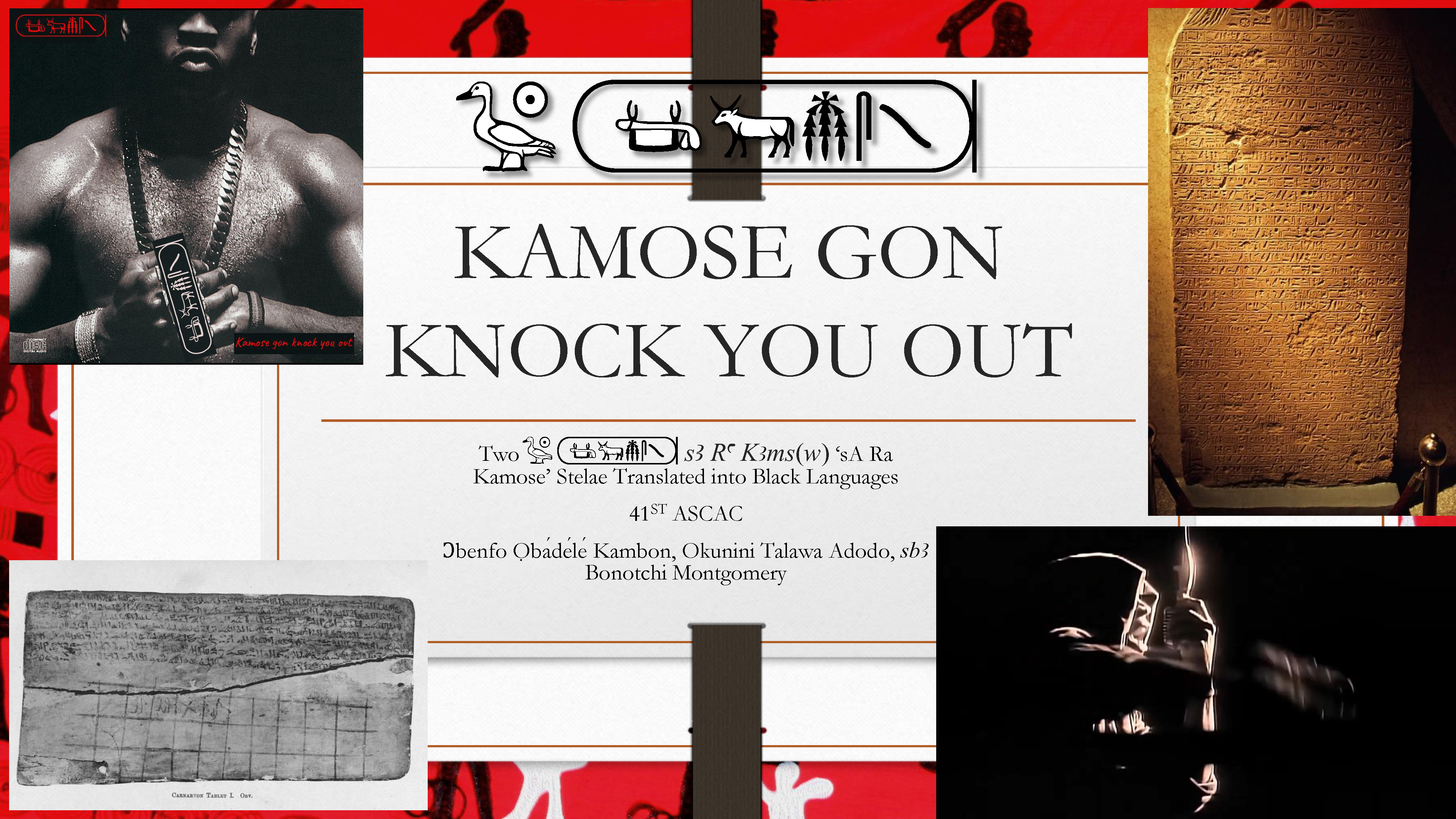
    The Kamose Stelae Black liberation analysis delivered at ASCAC 2025 is exactly the scholarship our people need right now. Ɔbenfo Ọbádélé Bakari Kambon — architect of Abibitumi and world-renowned Pan-Afrikan linguist — joined forces with Okunini Talawa Adodo and sbA Bonotchi Montgomery. Together, they brought a 49-minute intellectual and strategic masterclass to the 41st annual ASCAC conference. Furthermore, this presentation does not simply translate ancient text. It resurrects the living voice of our ancestors and points it directly toward Abibifahodie.

    Ɔbenfo Kambon grounds his scholarship in Afrikan languages, Afrikan thought, and the unapologetic pursuit of Black liberation. As a result, his work never sits comfortably inside colonial academic frameworks. Instead, it dismantles them. In this presentation, he and his colleagues move through the Kamose Stelae with linguistic precision, cultural authority, and strategic clarity. Most importantly, they demonstrate that the Kmtyw were not passive victims of history. They were warriors, planners, and liberators. That legacy belongs to us.

    Why the Kamose Stelae Black Liberation Framework Matters Today

    Pharaoh Kamose did not wait. He organized, strategized, and moved against the forces occupying Kemet. In addition, his recorded words — preserved in the stelae — carry strategic wisdom that speaks directly to our current struggle. Ɔbenfo Kambon and the presenters decode that wisdom using Afrikan languages, including Twi and Yoruba. Furthermore, they connect ancient military and political strategy to the living reality of Pan-Afrikan liberation today. This is not nostalgia. This is a roadmap.

    This exclusive recording is available now through Abibitumi — the premier platform for Pan-Afrikan education and community-centered liberation scholarship. Scholars, students, community builders, and parents fighting for their children’s minds will all find deep value here. Moreover, at just $20.00, this 49-minute presentation delivers irreplaceable knowledge that no mainstream institution will ever offer. However, access to this kind of scholarship requires that we support the infrastructure that makes it possible. Therefore, invest in your liberation today. Watch the full presentation and download the slides now.

    Watch / Get it here: Kamose Gon Knock You Out – ASCAC 2025 | Abibitumi

  • Five reasons to learn the Yorùbá language of Nigeria.

    Five reasons to learn the Yorùbá language of Nigeria.

    Yoruba is a widely spoken language in Nigeria and beyond. It is the native language of the Yoruba people, who are one of the largest ethnic groups in Nigeria and also have significant populations in Benin, Togo, and other West African countries.
    Learn Yorùbá today at Abibitumi.com
    1. Yorùbá is a widely spoken language in Nigeria and beyond. It is the native language of the Yorùbá people, who are one of the largest ethnic groups in Nigeria and also have significant populations in Benin, Togo, and other West African countries.
    2. Learning Yorùbá can help you communicate with a large and diverse group of people. Yorùbá is not only spoken in Nigeria, but also by communities in the Caribbean, South America, and the United States.
    3. Yorùbá culture is rich and vibrant, with a long history and a strong tradition of art, music, and storytelling. Learning the language can give you insight into this vibrant culture and allow you to fully appreciate its contributions to the world. This is particularly true to those initiated or considering being initiated into the Ifá/Òrìṣà tradition.
    4. Yorùbá is a tonal language, meaning that the pitch of a word can change its meaning. This can be a fun and challenging aspect of learning the language, and can also help improve your listening skills and attention to detail.
    5. Learning a new language has many cognitive benefits, including improved memory, problem-solving skills, and decision-making abilities. It can also increase your cultural awareness and understanding of different perspectives.

    Interested in learning Yorùbá? Sign up with pre-eminent linguist and scholar Ọ̀jọ̀gbọ́n Ọbádélé Kambon and start your journey to mastering Yorùbá today! https://stg-abibitumi-rpd-3fbq.ue1.rapydapps.cloud/shop/premium-introductory-conversational-yoruba-2023/