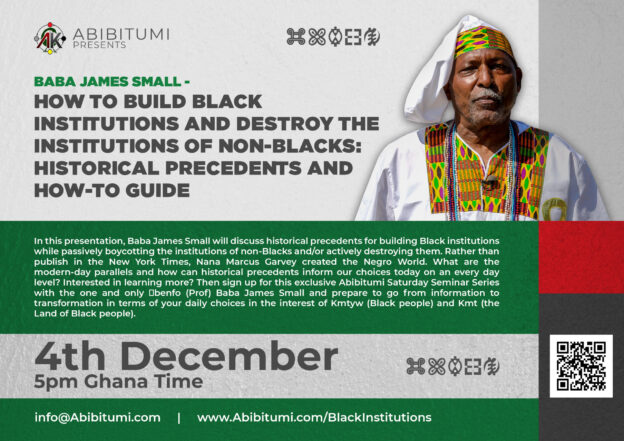
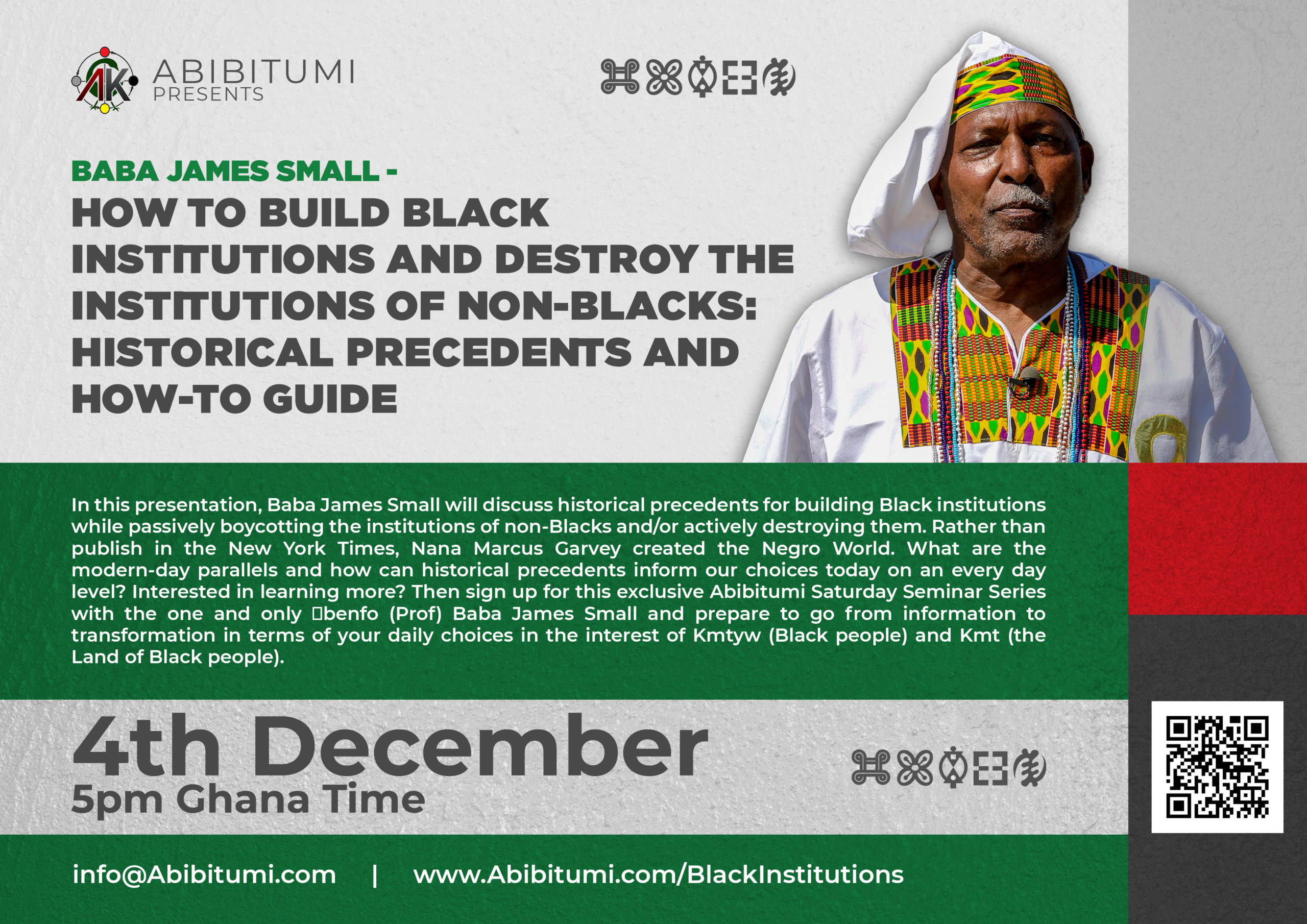
Learning how to build Black institutions is one of the most urgent tasks facing Kmtyw today. Nana Marcus Garvey did not beg the New York Times for space. Instead, he created the Negro World. That choice was deliberate. Furthermore, it was transformative. This is the tradition Ɔbenfo Baba James Small carries forward — boldly, brilliantly, and without apology.
How to Build Black Institutions: Strategy, History, and Everyday Action
In this powerful Abibitumi Saturday Seminar Series recording, Ɔbenfo Baba James Small delivers a masterclass in institutional power. He examines historical precedents for building Black institutions while passively boycotting — or actively dismantling — the institutions of non-Blacks. Moreover, he connects those precedents directly to the choices we make today. Every purchase, every platform, and every school our children attend is a political act. As a result, knowledge of this history is not optional — it is essential.
Baba Small moves with precision. He does not simply recount history. He hands you the blueprint. In addition, he challenges every Kmtyw listener to move from information to transformation. This is Abibifahodie in practice — not as a slogan, but as a daily discipline. Most importantly, this seminar reminds us that our ancestors already solved these problems. We must study their solutions and apply them now.
Abibitumi exists to make this level of scholarship accessible to Black people everywhere — scholars, students, parents, and community builders alike. This recording is available for just $20.00. However, its value extends far beyond any dollar amount. If you are serious about Abibifahodie and committed to the liberation of Afrikan people globally, this seminar belongs in your collection. Watch it. Study it. Act on it.
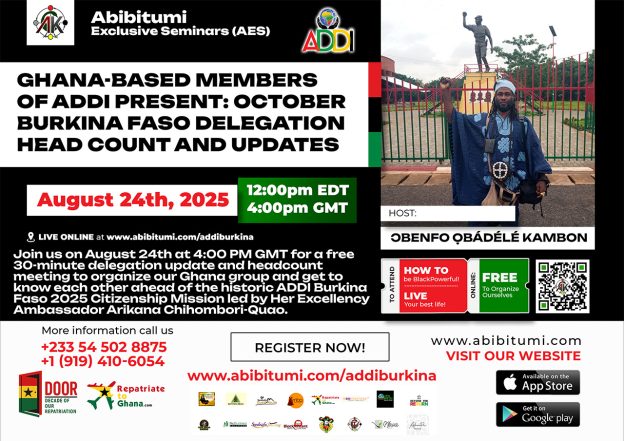
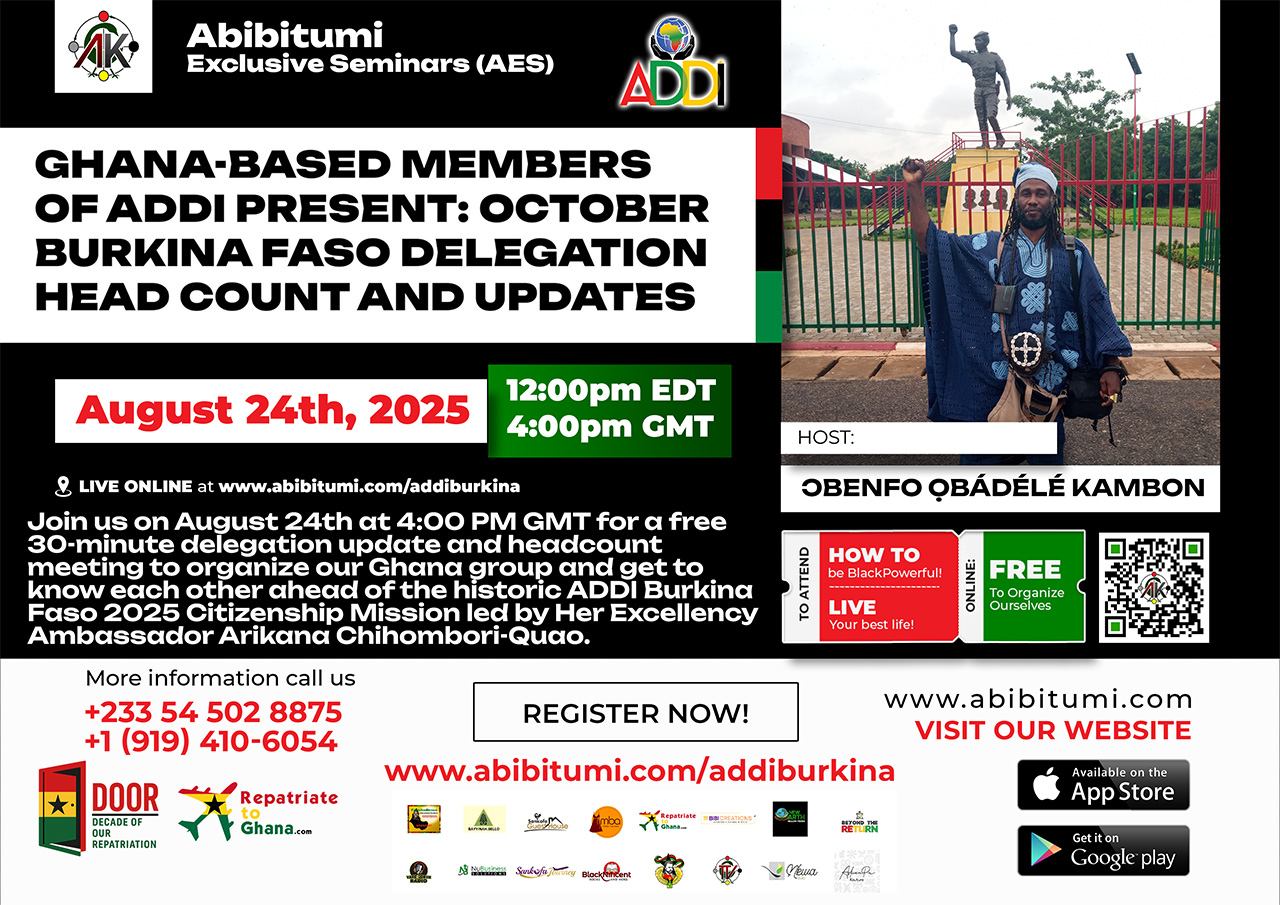
The Burkina Faso 2025 delegation is gathering, organizing, and preparing for one of the most meaningful journeys in recent Pan-Afrikan history. On August 24th, 2025, from 4:00 to 4:30 PM GMT, Abibitumi hosts a free online update and headcount meeting for the Ghana chapter of this historic mission trip. Furthermore, this session is open to all who have answered the call to return, reconnect, and rebuild on Afrikan soil. Every seat in this meeting matters deeply.
Abibifahodie — Black Liberation — is not merely a concept. It is a lived commitment. This delegation represents that commitment in action. Through the African Diaspora Direct Investment (ADDI) initiative, Afrikan people are actively reclaiming citizenship and planting roots in Burkina Faso. Moreover, this mission trip is part of a long tradition of Pan-Afrikan return that Abibitumi has championed for years. Ɔbenfo Ọbádélé Bakari Kambon, world-renowned linguist, scholar, and the architect of Abibitumi, has long emphasized that Afrikan people must move beyond symbolism into sovereign, practical action. This delegation embodies that teaching directly and powerfully.
Why the Burkina Faso 2025 Delegation Demands Your Full Attention
This is not a tourist trip. This is a strategic, community-led return to the Motherland. The Ghana delegation update meeting exists to ensure every participant is informed, connected, and ready. In addition, it gives delegation members the chance to align on logistics, ask critical questions, and build solidarity before departure. As a result, those who attend will move forward with clarity and confidence. Most importantly, this meeting is completely free. There is no barrier between you and preparation for this historic journey.
Abibitumi continues to create spaces where Afrikan people worldwide take bold, collective steps toward liberation. However, action requires preparation. This short 30-minute session offers exactly that — a structured, focused, community-centered moment to get aligned. Therefore, whether you are a confirmed delegation member or still considering your path, this meeting will ground you in what comes next. The Burkina Faso 2025 delegation is moving forward with purpose. Join your people, show up fully, and be counted. Register now and secure your place in this historic mission.
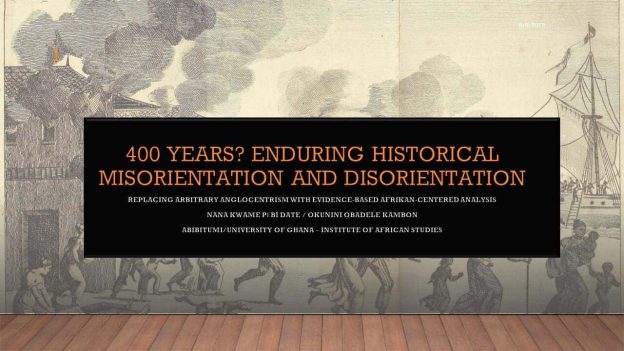
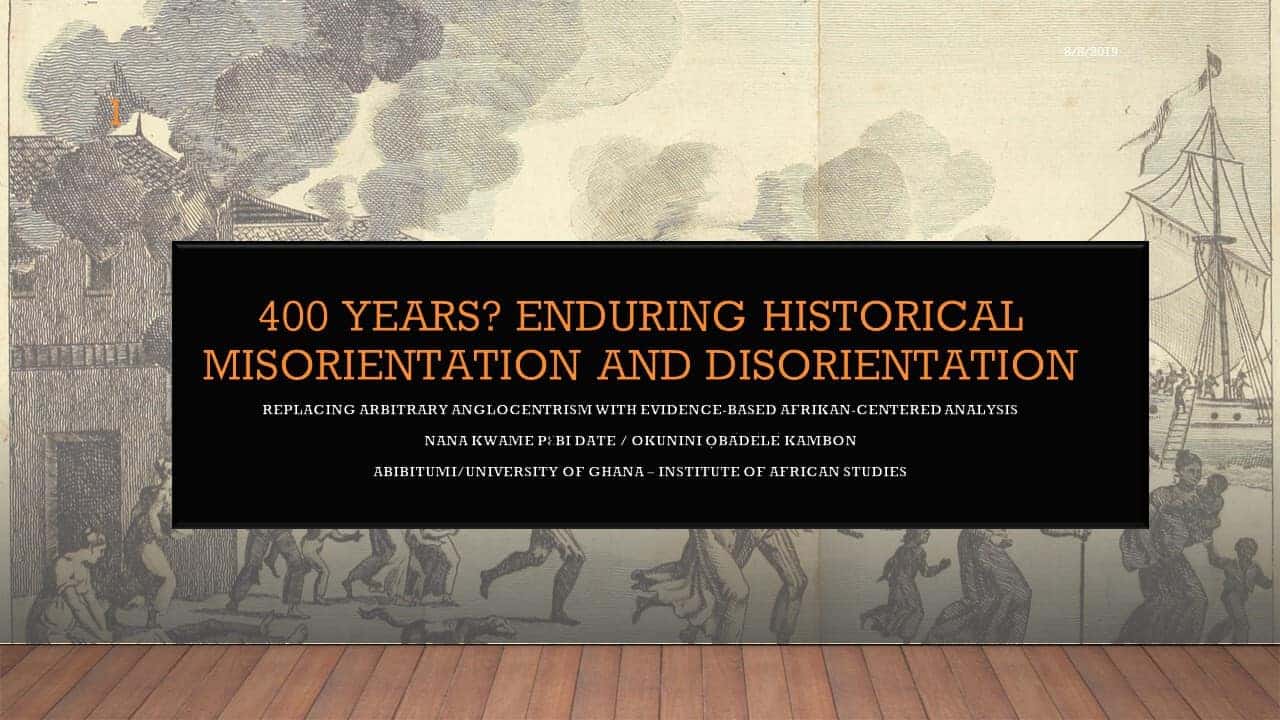
Afrikan history before 1619 is far richer, far more defiant, and far more liberating than the mainstream narrative ever acknowledges. Most people accept 1619 as the starting point of the Afrikan experience in the so-called Americas. However, that framing is a carefully constructed lie. In truth, Afrikan people were already resisting, rebelling, and building free communities on this soil nearly a century before that date.
In 1526, enslaved Afrikans at San Miguel de Guadalupe — in what colonizers called Spanish Florida — launched a successful rebellion. They drove off the Spanish. They won their freedom. Furthermore, they became permanent settlers, establishing one of the first free Black communities in the western hemisphere. Similarly, throughout the 1500s and into the early 1600s, Afrikan people across the so-called new world emancipated themselves and built free republics. These were not footnotes. These were acts of sovereign power. In addition, the transatlantic trade itself began not in 1619 but in 1441 — a fact that exposes the 400-year framing as a deliberate misdirection.
Ɔbenfo Kambon Breaks Down the Misorientation Rooted in Afrikan History Before 1619
Ɔbenfo Ọbádélé Bakari Kambon — Pan-Afrikan linguist, scholar, and architect of Abibitumi — delivers a masterful analysis of this historical misorientation in his lecture, 400 Years? Enduring Historical Misorientation and Disorientation and the Year of Return. He does not simply correct the record. Most importantly, he reveals why the misdirection exists and who benefits from it. He connects this distortion directly to the ongoing psychological and spiritual disorientation of Afrikan people worldwide. As a result, this lecture is not merely academic — it is a tool for Abibifahodie, Black Liberation itself.
Abibitumi exists to provide Afrikan people with exactly this kind of weaponized knowledge. Therefore, this lecture belongs in every home, every classroom, every community circle committed to truth. Understanding our full history — unfiltered and unapologetic — is the foundation of liberation. Furthermore, when we know how far back our resistance goes, we reclaim our power. We reclaim our identity. We reclaim our future. Do not allow a single colonial date to define the magnitude of who we are and all that our ancestors accomplished. Watch this lecture. Study it. Share it.
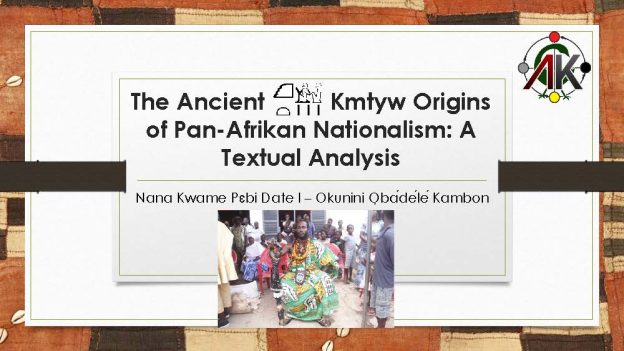
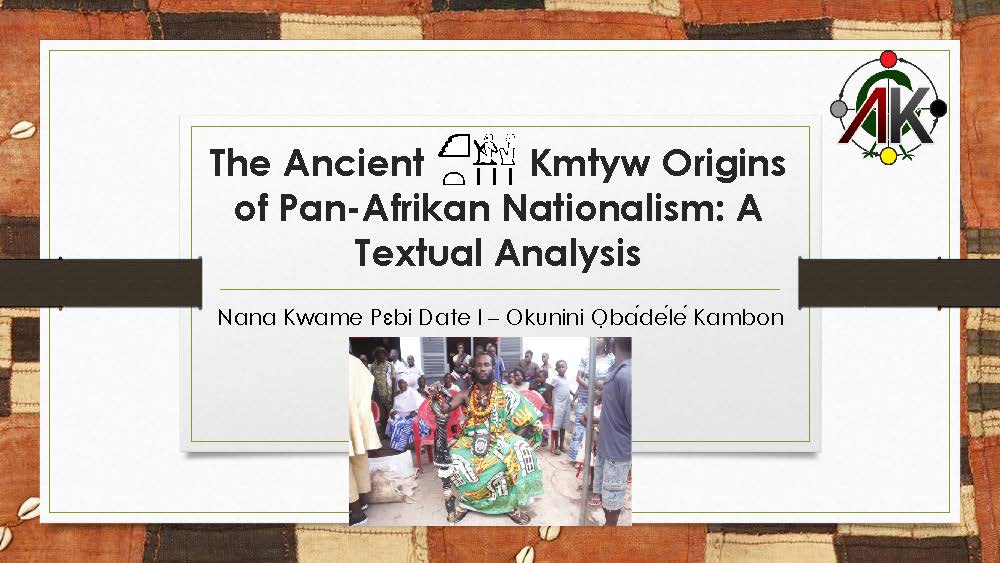
Ancient Pan-Afrikan nationalism is not a modern invention — it is a living inheritance coded into the very foundations of Afrikan civilization. Our ancestors unified Black people across vast territories long before European colonizers drew their artificial borders. This truth demands documentation. Furthermore, it demands celebration. Ɔbenfo Ọbádélé Bakari Kambon — world-renowned Pan-Afrikan linguist and architect of Abibitumi — delivers exactly that in this powerful and necessary lecture.
In this presentation, Ɔbenfo Kambon draws directly from primary textual sources to demonstrate that Kmt — the Land of Black people — operated with an intentional foreign policy of integration. That policy unified Afrikan peoples, ethnicities, and kingdoms into progressively larger socio-political formations. Moreover, this same unifying impulse appears across Wagadu, Nyani, Gao, Kȝš, Wene we Kôngo, Dzimba-hwe, Buganda, Kanem-Bornu, Meroë, and many more. These were not coincidences. They were a consistent Afrikan imperative.
The Kmtyw Laid the Foundation for Ancient Pan-Afrikan Nationalism
Most importantly, this lecture does not theorize from the outside looking in. Ɔbenfo Kambon anchors every argument in textual analysis — reading the evidence left by the Kmtyw themselves. As a result, Abibifahodie-minded scholars, students, and community builders receive a rigorous and unapologetic foundation for understanding Black unity as ancestral practice. This is not borrowed ideology. This is our own story, recovered and reclaimed through disciplined scholarship.
In addition, this work directly serves the mission of Abibitumi — equipping Afrikan people globally with the intellectual and historical tools needed for total liberation. Pan-Afrikan unity is not a dream deferred. It is a documented, ancient, and ongoing reality. Therefore, every Afrikan serious about Abibifahodie needs this lecture in their library. Watch it, study it, and share it widely. Get it here: The Ancient Kmtyw Origins of Pan-Afrikan Nationalism — $20.00.
Ɔbenfo Ọbádélé Kambon at Akuapem Mampɔn – Photo Credit Francis Kokoroko
by Farai Shawn Matiashe | Journalist Mutare, Zimbabwe
1. How significant is Black History Month to us here in Africa?
I’ve found that most people are not aware of it. In 2015, I initiated the Black History Month Film Festival in conjunction with the African World Documentary Film Festival. It was a significant effort to conscientize the public here in Ghana about the significance of Black History Month focusing some years on themes like Afrikan People solving Afrikan Problems and the like. We have held this event at the University of Ghana and now at the National Film and Television Institute. Because many are unaware of Black History Month, it is not something that has government support in terms of programming and oftentimes, efforts to do Black History Month events are simple due to individual initiative. While Black History Month is important, I have found that when teaching Intro to African Studies–a required course for all 200 level students at the University of Ghana, most students know a lot of non-Black history but very little Black History. They can tell you about Albert Einstein, but not Imhotep. They can tell you about Napoleon, but not Jean Jacques Dessalines. They can tell you about jesus, but not Heru. And the list goes on. This underscores the important role that Black History Month could play but is yet to do so due to unfulfilled promise and lack of coordinated efforts in this vein. According to Baba Ọmọ́wálé (Malcolm X) “Of all our studies, history is best qualified to reward our research.” What we see here on the continent, by and large, is the effect of ignorance of history in all facets of life. This is unacceptable and is the reason for my own efforts in this area. In 2017, I instituted Black History Month and Beyond as the theme to underscore 365 days of Black History through https://stg-abibitumi-rpd-3fbq.ue1.rapydapps.cloud . This is a social education (not social media) platform where Black people come together to share information including, but not limited to Black History, Black Health, Black Economics and various aspects of that which is necessary for the pursuit of Black power as the name indicates (Abibitumi translates to Black Power in the Akan language of Ghana). Since that time, we have launched an app accessible via App and Play Stores and, this year, we have the 1st Historic Abibitumi Conference on Black Power. Via this initiative, we will highlight Black History as a practical vehicle for the pursuit and attainment of Black Power by connecting knowledge of the past to possibilities of the future. You can find out more about the Abibitumi Conference on https://stg-abibitumi-rpd-3fbq.ue1.rapydapps.cloud/conference
For me, it is not enough to simply have information, that information should have a behavioral correlate; an actionable component. This is why Abibitumi has become a central component of the lives of thousands of Black people throughout the world. Beginning as an avenue for the teaching of Asante Twi, Yorùbá, Wolof, Kiswahili and mdw nTr, it has become a means by which Black people can educate and be educated in all areas of human activity including, but not limited to, Economics, Education, Entertainment, Labor, Law, Politics, Religion, Sex and War.
2. It seems the Month is not taken seriously here on the continent. Only some isolated events are usually held to celebrate it. Don’t you think Black History Month should be a common platform to revive pan-Africanism on the continent?
It’s not as simple as saying it’s not taken seriously. It’s not even known by many. You can see my response above on the isolated events. As pertaining to the second question, one of the main issues at hand is the Hijacking of Pan-Afrikanism by continentalists who are against “Blackness” as a concept and would rather lump the indigenous Black people with our past, current and future colonizers like the arabs, who have invaded North Afrika and the Dutch Boers, who have invaded South Afrika. The 5th Pan-Afrikan Congress was central to the hijacking of Pan-Afrikanism from being a concept about Black people regardless of location to being a frankenstein concept about location regardless of whether one is Black or not. The concept of Black itself (and here, specifically in the context of Black History Month) is one that can challenge the hijacking of Pan-Afrikanism by returning us to the idea that pervaded our consciousness in classical Kmt (contemporarily misnamed “Ancient Egypt”). In Kmt, we called ourselves Kmtyw ‘Black people’. We called our land Kmt, translating to land of the Black people, much like what Ethiopia meant to the greeks, Niger meant to the Romans and Bilad as Sudan meant to the arabs–all of the above translating to land of Black people in what amounts to basically a calque of the meaning of Kmt. With regard to reviving original authentic Black Pan-Afrikanism, this is not something that is just for the continent, but, again, for Black people regardless of location–although there are clear implications in terms of making this land once again the Land of Black People. My efforts in this regard are multifold. One is the Abibitumi ‘Black Power’ platform mentioned in response to the previous question whereby Black people own, control and operate our own means of communication rather than depending on our past, current and future enemies. Another is the initiative called https://www.sankofajourney.com, which my mother, Okuninibaa (Dr.) Mawiyah Kambon founded in 1998 and is the reason why I first came to Ghana. In fact, it is ultimately the reason I learned Twi, live in Ghana and now have a family here with my wife and 5 children and my parents living with us. Through the Sankɔfa Journey, for the past 25 years, we have been bringing Black people from the western hemisphere including the united snakkkes, the Caribbean, the u.kkk. and more here to Ghana, Togo and Benin on transformative life-changing experiences. Rather than just a “tour” it is a spiritual reconnection where Black people can reclaim our indigenous names, eat our foods, learn our languages (I teach Twi to Sankɔfa Sojourners) and more. Another initiative is https://www.repatriatetoghana.com whereby we assist Black people in reconnecting with the land of Black people (now known as Afrika, but that should properly be called Kmt (mdw nTr a.k.a. Ancient Egyptian Hieroglyphs), Abibiman (Twi), Ilẹ̀ Adúláwọ̀ (Yorùbá), Farafina (Bamanakan), Réewu nit ku Ñuul (Wolof), Nsi a Bandômbe (Kikôngo), Ala Ndi Isi Ojii (Igbo) and others all translating to The Land of Black People). This is an initiative whereby we assist repatriates with acquisition of land, Ghanaian citizenship, shipping, housing, continuing education and more. I will discuss more about Repatriate to Ghana (https://www.r2gh.com) below.
3. What are your thoughts on racial inequalities still existing in countries such as South Africa and the killings of blacks by white in the US? For instance, the death of George Floyd and more recently violent beating of Tyre Nichols by Memphis police. My thoughts are the Black people should put our efforts towards building the land of Black people so that we can not only resist, but defeat our non-Black enemies (as well as internal enemies who directly or indirectly serve the interests of our non-Black enemies–as in the case of the anti-Black police officers who beat Tyre Nichols to death). Specifically, in the case of the Tyre Nichols beating, I am reminded of the words of Nana Bobby Wright: “Blacks kill Blacks because they have never been taught to kill whites.” In terms of the continued killing of Blacks by whites, the question is not one of racial inequalities but a question of power and lack thereof for Black people. In the words of Nana Kwame Ture, “If a white man wants to lynch me, that’s his problem. If he’s got the power to lynch me, that’s my problem. Racism is not a question of attitude; it’s a question of power.” According to Grandcestor Nana Amos N. Wilson, “white people exercise racism because they have the power to do so.” Consequently, defeating eurasians–western and eastern–is ultimately about the power to disable them. That is to say, to remove their ability to practice systemic, group and individual racism and genocide against Black people.As such, rather than financing our enemies in the united snakkkes and the like, it behooves us to divest from amerikkka–that is a divestment in terms of our T.E.R.M.S.: Time, Energy, Resources, Money and Spirit as coined by my father Ɔbenfo (Professor) Kamau Kambon. This divestment from amerikkka is concomitant with investment in the land of Black people. Again, for me it is not enough to simply think about an idea, but there must be a behavioral correlate: this is the reason for my https://www.repatriatetoghana / https://www.r2gh.com initiative. If I am serious about assisting Black people in divesting from amerikkka and investing in the Land of Black people, I must provide avenues and assistance in this regard. It is very difficult to defeat and ultimately permanently disable an enemy who you finance and support with your T.E.R.M.S. At the same time, it is difficult to build the systems, structures, processes and infrastructure necessary to defeat our enemies while at the same time supporting them and not supporting our own. Through https://www.repatriatetoghana.com, I am able to turn my ideas into actions working towards the building of a Black power base in alignment with those ideas.
4. Feel free to add more information that may be relevant to this story.
It is not enough to think good thoughts while working for our so-called white enemies. It is not enough to simply know Black History while not acting on it in tangible, concrete ways. It is not enough to celebrate Black History Month while forgetting to act in the interest of our Black present and future. Kmtyw (Black People) must work to minimize Aggressive Ideological Mimicry and bring our thoughts into alignment with our actions when it comes to working to build Abibitumi (Black Power) in the pursuit of Abibifahodie (Complete and Total Black Liberation from under white/eurasian world terror domination). In pursuit of this goal, I have initiated several efforts including https://stg-abibitumi-rpd-3fbq.ue1.rapydapps.cloud, https://www.sankofajourney.com and https://www.repatriatetoghana.com
We have the upcoming Abibitumi Conference https://stg-abibitumi-rpd-3fbq.ue1.rapydapps.cloud/conference whereby we bring all these efforts together in synchrony in pursuit of Abibitumi (Black Power). For any Kmtyw (Black People) Interested in working with me or finding out more about what I do and why/how I do it, you are invited to join us on Abibitumi, join us for the Sankɔfa Journey and Repatriate to Ghana here in the land of Black people.
5. Kindly share your full name and designation
My full name is Ɔbenfo (Professor) Ọbádélé Bakari Kambon, founder of Abibitumi.com, founder of RepatriateToGhana.com and co-leader of SankofaJourney.com I am also Nana Kwame Pɛbi Datɛ, Ban mu Kyidɔmhene of Akuapem Mampɔn traditional area. Every day it’s up to us to make the Black History that our descendants will talk about. In the words of Nana Amilcar Cabral: ““We must act as if we answer to, and only answer to, our Ancestors, our children, and the unborn.”
How to Build Black Institutions That Last: Lessons from History for Afrikan Liberation
Report
There was a problem reporting this post.
Block Member?
Please confirm you want to block this member.
You will no longer be able to:
See blocked member's posts
Mention this member in posts
Invite this member to groups
Message this member
Add this member as a connection
Please note:
This action will also remove this member from your connections and send a report to the site admin.
Please allow a few minutes for this process to complete.