Tag: Ghana

  • Ghana Citizenship Ceremony Rescheduled: What Repatriates Must Know and Do Right Now

    Ghana Citizenship Ceremony Rescheduled: What Repatriates Must Know and Do Right Now

    Ghana citizenship repatriation

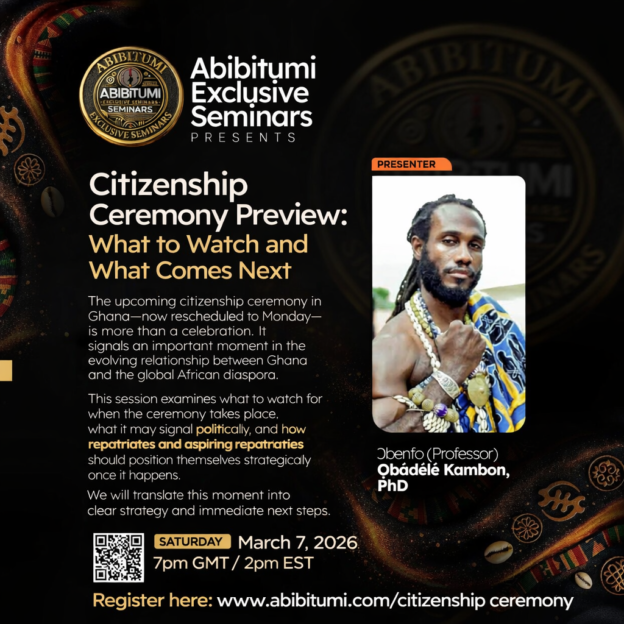
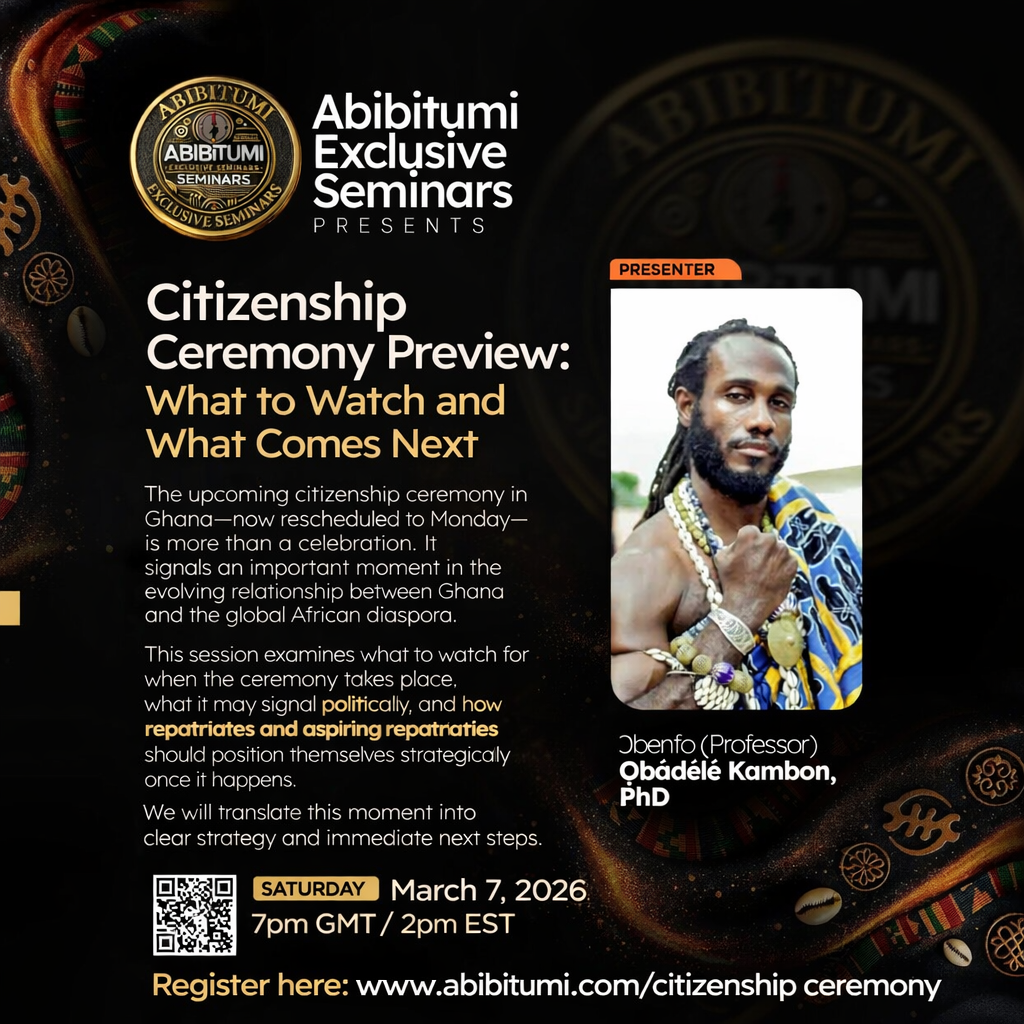
    Ghana citizenship repatriation just entered a critical new phase — and every serious repatriate needs to pay attention. The ceremony has been rescheduled to Monday. This shift is not simply logistical. It carries political weight, and it demands that Afrikan people in the Diaspora respond with clarity and strategy. Furthermore, waiting passively is not an option. Now is the time to position yourself with precision and purpose.

    Understanding the Ghana Citizenship Repatriation Roadmap After the Rescheduling

    Ɔbenfo Ọbádélé Bakari Kambon leads this essential session with the depth and directness that defines his life’s work. In this replay, he breaks down what the rescheduling may signal politically. He also explains how repatriates can move forward decisively using the DOOR framework. Most importantly, he maps out the full Diaspora Citizenship Roadmap so you know exactly where you stand. In addition, he connects this moment to the broader work of Abibifahodie — the total liberation of Afrikan people everywhere.

    This session is not theory for its own sake. Ɔbenfo Kambon gives you concrete next steps. He directs repatriates to the resources available through RepatriateToGhana.com so that forward movement stays practical and grounded. As a result, you leave this replay not just informed — but equipped. Every aspiring repatriate deserves that level of preparation. Abibitumi consistently delivers exactly that standard of Afrikan-centered education.

    The work of Abibitumi exists to serve Afrikan people globally — scholars, parents, students, and community builders committed to returning home in every sense. However, preparation separates those who move with power from those who remain uncertain. This replay is your strategic advantage. Do not wait for another rescheduling to find you unprepared. Watch it now, apply the framework, and take your next step toward home with confidence and intention.

    Watch / Get it here: AES – Ghana Citizenship Ceremony: What to Watch For and What to Do Now

  • The Truth About 400 Years: Centering Afrikan History Before 1619

    The Truth About 400 Years: Centering Afrikan History Before 1619

    Afrikan history before 1619

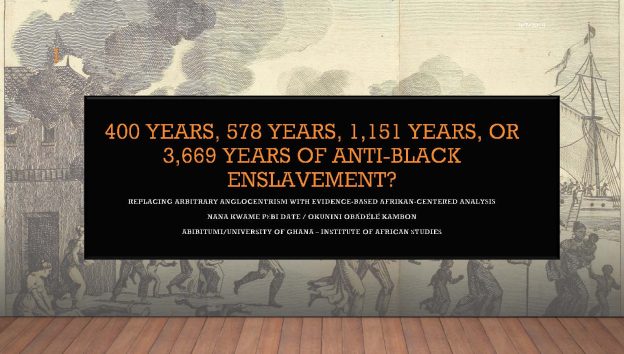
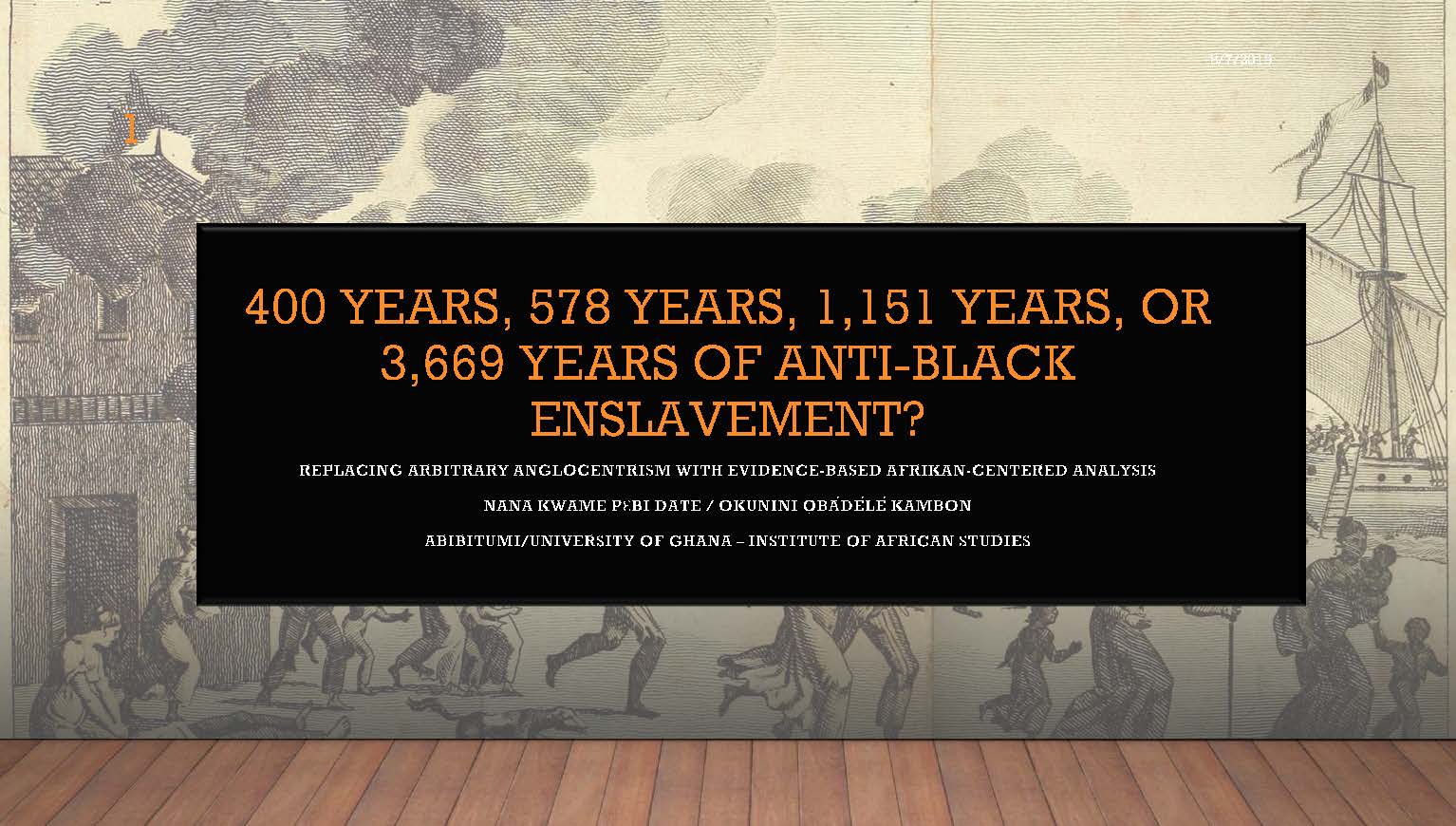
    Afrikan history before 1619 is far deeper, more powerful, and more liberatory than mainstream narratives ever acknowledge. The Anglo-American educational system has long anchored the Afrikan experience in the so-called “New World” to one date: 1619. However, that anchor is arbitrary. It is anglocentric. Furthermore, it erases centuries of Afrikan resistance, self-liberation, and nation-building that demand our full attention and respect.

    In 1526, enslaved Afrikans at San Miguel de Guadalupe — in what the Spanish called Florida — launched a successful rebellion. They drove off their captors. They won their freedom. As a result, they became permanent settlers in the western hemisphere long before any British colony took root. Throughout the 1500s and into the early 1600s, Afrikan people established the first free Black republics and settlements of the modern era. Most importantly, these acts of resistance were not isolated. They formed a continuous tradition of Abibifahodie — Black liberation — written in Afrikan blood, courage, and collective will. In addition, the transatlantic trade in enslaved Afrikans itself began as early as 1441, pushing the true timeline back nearly two centuries before 1619.

    How Ɔbenfo Kambon’s Afrikan-Centered Analysis Reclaims the Full Timeline

    Ɔbenfo Ọbádélé Bakari Kambon — master linguist, Pan-Afrikan scholar, and architect of Abibitumi — dismantles the 1619 framework with precision and power. He replaces anglocentric periodization with a rigorously Afrikan-centered analysis rooted in Ma’at. Furthermore, Ɔbenfo Kambon draws a direct line from the ancient Kmtyw through the resistance movements of the 1500s to our liberation struggles today. This is not revision for revision’s sake. Rather, it is the restoration of truth. His work equips Afrikan people globally — scholars, students, parents, and community builders — with the intellectual tools to see our full story clearly and act accordingly.

    This lecture is an essential resource for every serious student of Afrikan liberation. In it, Ɔbenfo Kambon challenges us to reject borrowed timelines and build our analysis from Afrikan ground. Abibitumi exists precisely for this purpose — to center Afrikan knowledge in service of Afrikan freedom. Therefore, do not let this pass you by. Watch this presentation, share it with your community, and invest in the scholarship that moves us toward Abibifahodie. Get it here for just $20: Watch / Get it here →

  • Ghana’s U.S. Military Base Agreement — What They Don’t Want You to Know

    Ghana’s U.S. Military Base Agreement — What They Don’t Want You to Know

    Ghana US military base agreement

    The Ghana US military base agreement demands serious scrutiny from every Afrikan person on the continent and in the diaspora. Ɔbenfo Ọbádélé Bakari Kambon delivers exactly that scrutiny — with precision, depth, and unapologetic clarity. This powerful seminar pulls back the curtain on how the united snakkkes operates on the world stage. Most importantly, it shows what that operation means for Afrikan sovereignty.

    Ɔbenfo Kambon traces united snakkkes foreign policy from George Washington straight through to Henry Kissinger. Furthermore, he demonstrates that unilateralism is not a bug in the system — it is the system. The evidence is overwhelming. Case studies include the 1993 Chemical Weapons Convention, the 1963 Vienna Convention on Consular Relations, and repeated failures to pay dues under the United Nations Charter. In addition, the research draws on Koplow (2013) and numerous other documented treaty violations. As a result, a clear pattern emerges: the united snakkkes does not keep its word.

    Why the Ghana US Military Base Agreement Is a Pan-Afrikan Crisis

    This is not simply about Donald Trump. However, Trump does continue a tradition that stretches back centuries. Ɔbenfo Kambon’s research shows that “Politicians” and “Prostiticians” are two sides of the same colonial coin. Furthermore, Ghana’s decision to enter this military agreement does not exist in a vacuum. It connects directly to that long, documented history of broken promises and predatory policy. Afrikan leaders must therefore understand exactly who they are negotiating with — and what that entity has consistently done to those who trust it.

    This lecture is part of Abibitumi’s exclusive Seminar Series — built for Afrikan scholars, students, parents, and community builders committed to Abibifahodie. Ɔbenfo Kambon does not water down the analysis. Instead, he arms our community with the historical record we need to think clearly and act decisively. Furthermore, the full video recording and slides are available now for just $20.00. Watch it, study it, and share it with every Afrikan person in your circle who is serious about liberation.

    Watch / Get it here: Politicians, Prostiticians, and The Ghana United Snakkkes Military Base Agreement — Abibitumi Seminar Series

  • Ghana Citizenship Crisis: What Every Diasporan Must Know Before It’s Too Late

    Ghana Citizenship Crisis: What Every Diasporan Must Know Before It’s Too Late

    Ghana citizenship Diaspora

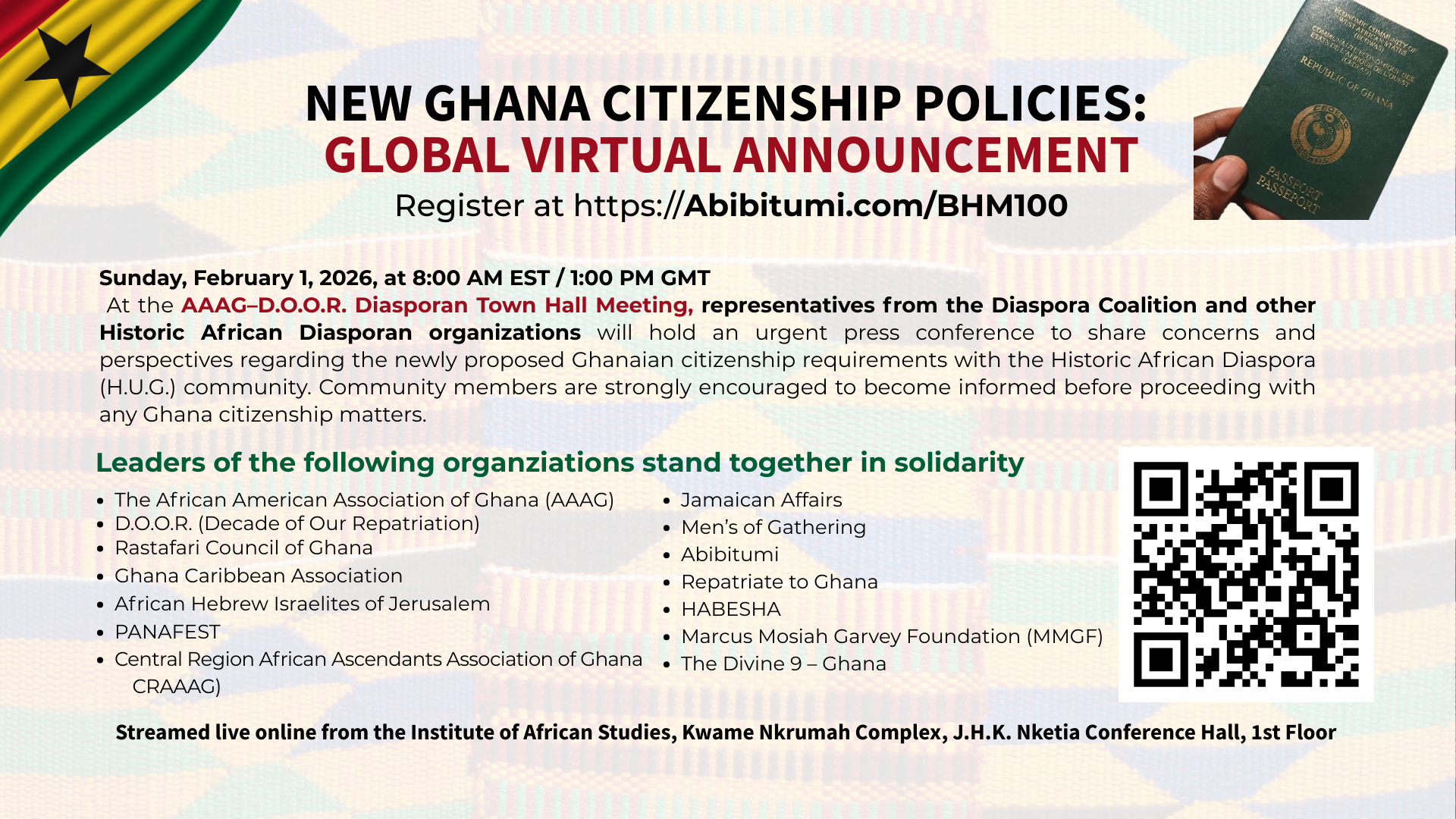
    Ghana citizenship for Diasporans is under serious pressure — and this moment demands your full attention. Historic Diasporan leaders in Ghana have already convened to unite around urgent concerns about new citizenship criteria. Now, they are bringing that conversation directly to you. This free town hall is your opportunity to hear directly from those on the ground. Furthermore, it arrives at a profoundly symbolic moment — the 100th anniversary of Nana Carter G. Woodson’s launch of Black History Month in 1926.

    Baba James Small unpacks the full arc of that centennial legacy — from Woodson’s original blueprint to the concrete action our people must take today. Moreover, Ɔbenfo Ọbádélé Bakari Kambon and Abibitumi have built this platform precisely for moments like this one. This is not a passive webinar. It is a strategic assembly for Afrikan people who are ready to move from reflection to resolution. In addition, if you have ever considered relocating to Ghana or anywhere on the continent, this session speaks directly to you.

    Why This Ghana Citizenship Town Hall Cannot Wait

    The political climate in the United States, United Kingdom, and across the Diaspora is shifting rapidly. As a result, more Afrikan people are seriously exploring return — not as fantasy, but as strategy. However, shifting citizenship criteria in Ghana mean that your window to act may be narrowing. This panel brings together Diasporan leaders, legal voices, and community builders to give you clarity. Most importantly, they offer a path forward grounded in Abibifahodie — Black liberation — not fear.

    This is a free, live event hosted through Abibitumi — the premier Pan-Afrikan education and liberation platform built by Ɔbenfo Ọbádélé Bakari Kambon to serve our people globally. Therefore, whether you are a scholar, a parent, a student, or a community organizer, your presence matters here. Register now and show up ready to build. This centennial moment calls for clarity, courage, and collective action — and Abibitumi is holding the space for exactly that. Watch and register here: Diaspora Town Hall — What Does Citizenship in Afrika Mean to Me?

  • Before 1619: Reclaiming the Full Truth of Afrikan Resistance and Freedom

    Before 1619: Reclaiming the Full Truth of Afrikan Resistance and Freedom

    Afrikan resistance before 1619

    Afrikan resistance before 1619 is far older, far bolder, and far more victorious than mainstream narratives dare to teach. Most people have been handed 1619 as the beginning of the Afrikan story in the western hemisphere. However, that starting point is a deliberate misorientation. In truth, by 1526 — nearly a century earlier — enslaved Afrikans at San Miguel de Guadalupe had already defeated the Spanish and established free settlements. Their victory was real. Their freedom was won. Furthermore, this was not an isolated moment but the beginning of a long, powerful chain of resistance.

    In addition, the history reaches back even further. By 1441, the European trafficking of Afrikans had already begun — more than 175 years before Jamestown. These are not footnotes. They are foundations. Most importantly, when we accept 1619 as the starting point, we erase generations of Afrikan freedom fighters who triumphed long before that date. As a result, our understanding of ourselves becomes fractured and incomplete. Abibifahodie demands that we reclaim every year, every victory, and every name.

    How Ɔbenfo Kambon’s Lecture Reorients Afrikan Resistance Before 1619

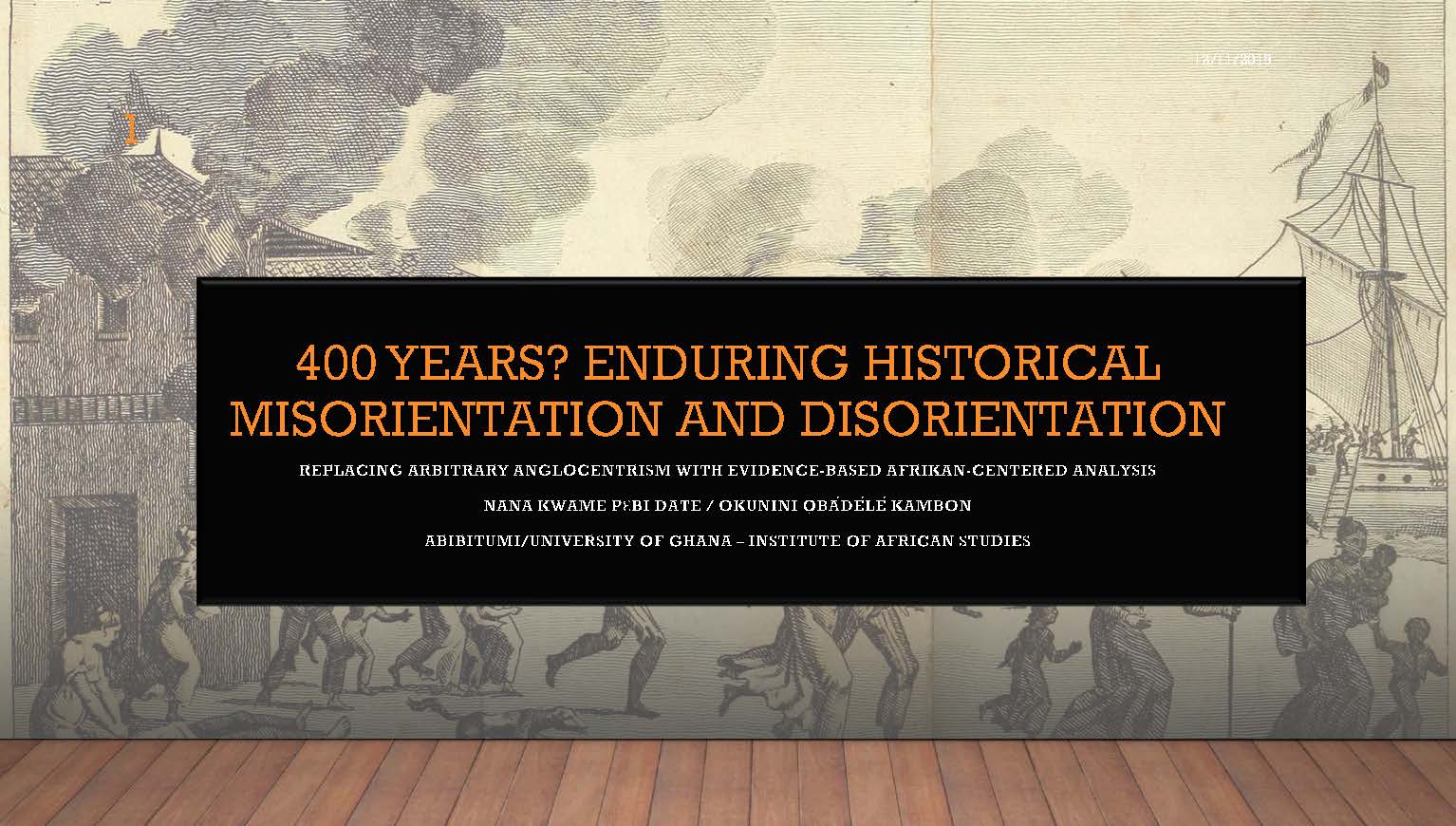
    Ɔbenfo Ọbádélé Bakari Kambon — linguist, scholar, and architect of Abibitumi — delivers this truth with scholarly precision and unapologetic clarity. His lecture, Nakumbuka: 400 Years? Enduring Historical Misorientation and Disorientation, dismantles the colonial timeline piece by piece. Furthermore, he does not simply critique — he rebuilds. He equips Afrikan people with accurate historical grounding. Moreover, the accompanying slides make this knowledge accessible for students, educators, and community builders alike. This is the kind of scholarship that Abibitumi was built to carry.

    Knowledge rooted in Ma’at is knowledge that liberates. Therefore, this lecture is not merely academic — it is a tool for Abibifahodie. Every Afrikan who watches it walks away more grounded, more equipped, and more dangerous to the systems built on our disorientation. In addition, at only $20, this exclusive video and slide package puts world-class Pan-Afrikan scholarship directly in your hands. Do not let another year pass on a false timeline. Reclaim the full story of your people. Watch and get it here: Nakumbuka — Exclusive Video & Slides at Abibitumi.