Tag: dr kamau kambon

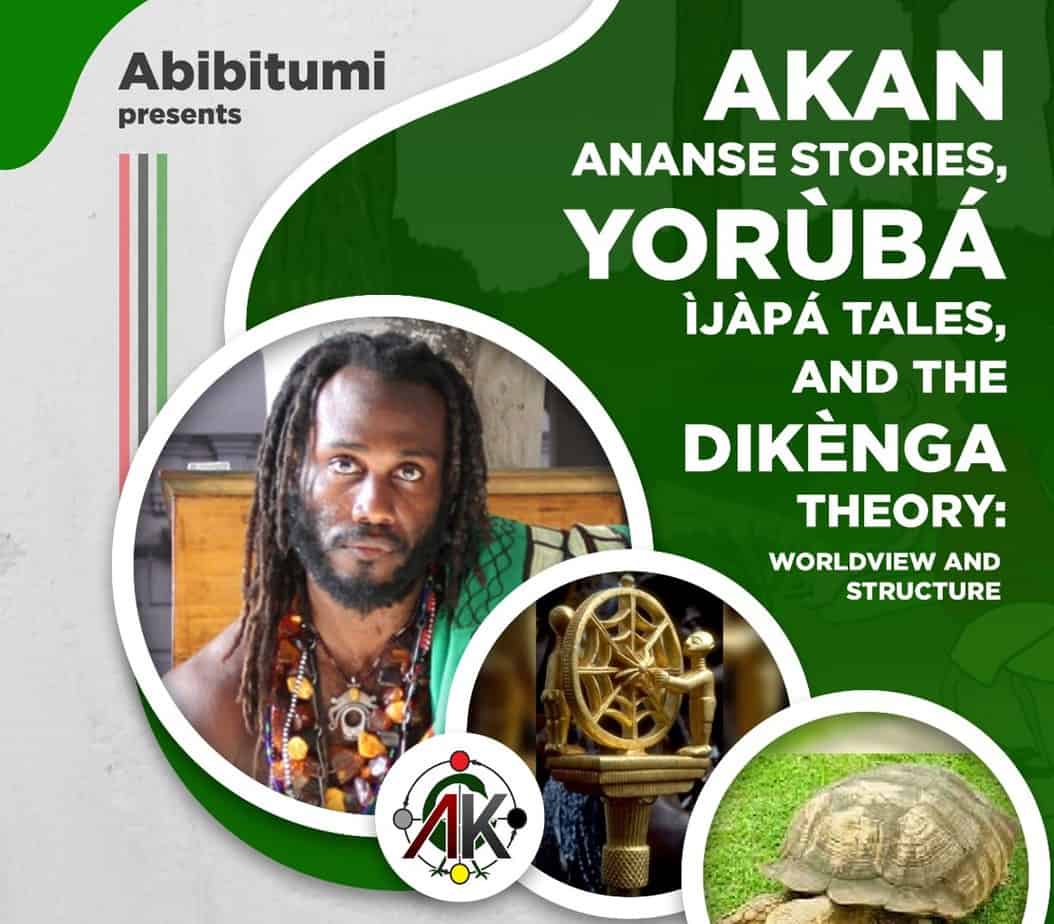
  • Akan Ananse, Yorùbá Ìjàpá, and the Dikènga Theory: Reclaiming Afrikan Literary Analysis

    Dikènga theory Afrikan stories

    The Dikènga theory Afrikan stories framework reveals something profound: our stories were never simply linear. They move in cycles. They mirror the cosmos. Ɔbenfo Ọbádélé Bakari Kambon — Pan-Afrikan linguist, scholar, and architect of Abibitumi — presents a revolutionary lecture applying the Bakôngo cosmogram to Akan Ananse and Yorùbá Ìjàpá tales. As a result, what emerges is a wholly Afrikan method of literary analysis. Furthermore, this approach dismantles the Eurocentric lens that has long distorted our understanding of Afrikan oral tradition.

    Fu-Kiau declared that “nothing exists that does not follow the steps of the cyclical Kongo cosmogram.” Ɔbenfo Kambon takes that declaration seriously. He tests it rigorously. In this study, he applies what he terms the Dikènga theory of literary analysis to these beloved story traditions. Consequently, concepts like “storylines” and “timelines” give way to something deeper — patterned, cyclical structures embedded in material, spatial, and temporal phenomena. Most importantly, this is not a borrowed framework. This is Afrikan cosmology doing exactly what it was designed to do.

    Why the Dikènga Theory Transforms How We Read Afrikan Stories

    Ananse and Ìjàpá are not merely trickster figures. They are cosmological agents. Their stories encode the worldview, structure, content, and function of Afrikan thought. However, Western literary theory has consistently failed to honor this depth. The Dikènga theory Afrikan stories approach corrects that failure completely. In addition, it gives scholars, students, parents, and community builders a powerful tool rooted in our own intellectual traditions. Abibifahodie demands that we stop interpreting ourselves through outside eyes. This lecture answers that demand directly and boldly.

    This lecture comes with both video and slides. Therefore, you can engage the material visually and analytically. Whether you are a seasoned scholar or a first-generation student of Pan-Afrikan thought, this resource meets you fully. Moreover, the Abibitumi platform exists precisely to deliver this level of scholarship directly to Afrikan people globally. This is liberation education. This is Kmtyw wisdom applied to Afrikan literary heritage. Do not miss it. Watch the full lecture and download the slides today.

    Watch / Get it here: VIDEO + SLIDES: Akan Ananse Stories, Yorùbá Ìjàpá Tales and the Dikènga Theory

  • Repatriate to Ghana: A Real Success Story You Need to Hear

    repatriate to Ghana

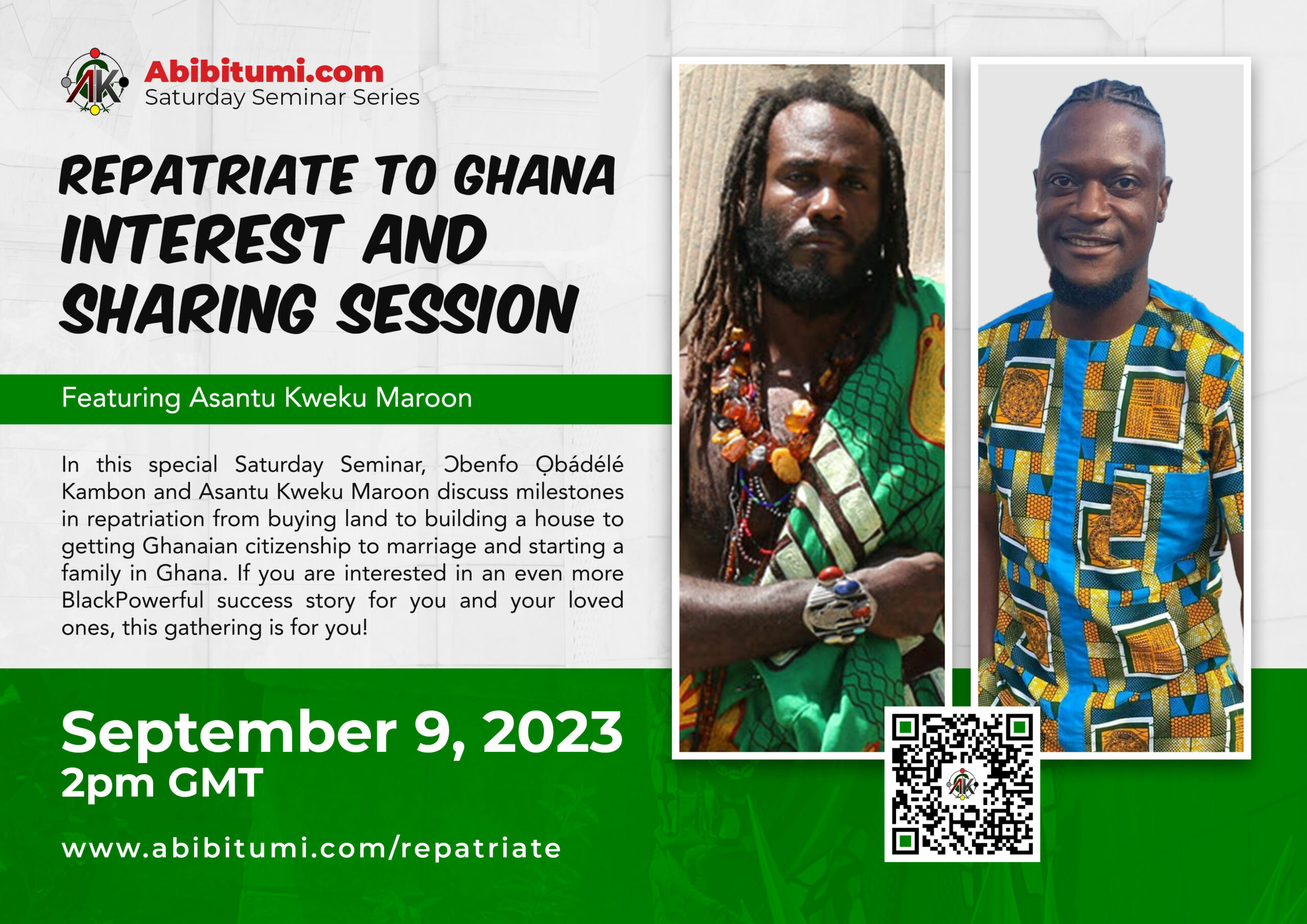
    If you are ready to repatriate to Ghana, this session delivers exactly what you need — real answers from people who have already done it. On 9 September 2023, Ɔbenfo Ọbádélé Bakari Kambon hosted a powerful Saturday Seminar alongside Asantu Kweku Maroon. Together, they walked through the full journey of building a life on Afrikan soil. Furthermore, this conversation speaks directly to every Black person globally who is serious about Abibifahodie in action.

    How Asantu Kweku Maroon’s Story Shows You Can Repatriate to Ghana Successfully

    Asantu Kweku Maroon is one of Ghana’s most successful repatriates. His story covers buying land, building a home, obtaining Ghanaian citizenship, marriage, and starting a family. In addition, Ɔbenfo Kambon guides the discussion with the scholarly depth and liberatory clarity that Abibitumi is known for worldwide. As a result, this session is not inspiration alone — it is a practical roadmap grounded in lived experience.

    Most importantly, this seminar answers the questions our community actually asks. How do you navigate land ownership? How do you secure citizenship? What does daily life truly look like after repatriation? Ɔbenfo and Asantu Kweku address each milestone honestly and directly. Moreover, they speak to you as Afrikan people building power — not as immigrants seeking permission, but as people returning home with intention and vision.

    Abibitumi exists to equip our people with knowledge that produces liberation. This recording is a living example of that mission. Whether you are a scholar, a parent, a community builder, or simply someone ready to move, this session meets you where you are. However, do not let readiness sit idle — take the next step today. Watch this BlackPowerful session and let the testimony of those who have walked the path light yours.

    🎥 Watch / Get it here: Repatriate to Ghana Interest and Sharing Session — Video Recording

  • One Afrikan Mind: Body Part Expressions Across Akan, Yorùbá, Kiswahili, and Mdw Ntr

    Afrikan language body expressions

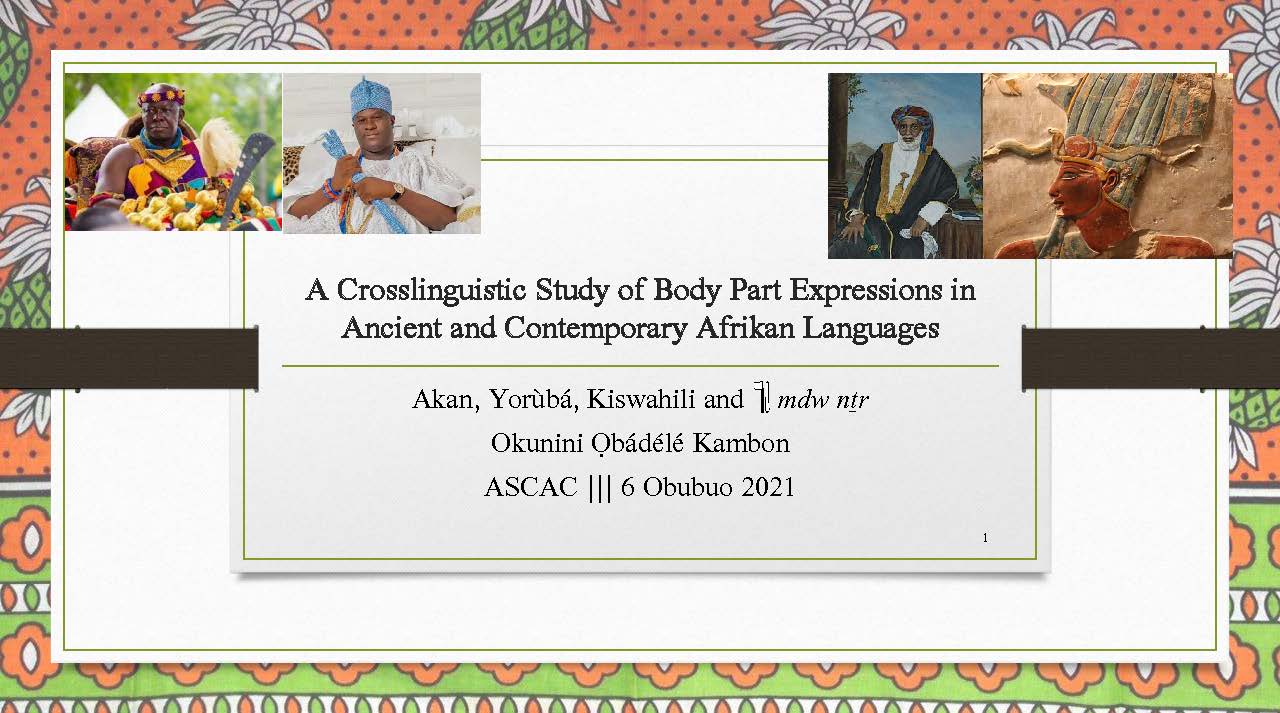
    Afrikan language body expressions carry a power that most academic institutions will never teach. They reveal something profound — that Afrikan people, across centuries and continents, share a continuous and unified worldview. In this landmark 2021 ASCAC presentation, Ɔbenfo Ọbádélé Bakari Kambon demonstrates exactly that. He traces linguistic patterns from Akan, Yorùbá, and Kiswahili all the way back to mdw nTr — the sacred language of the Kmtyw themselves.

    How Afrikan Language Body Expressions Reveal a Shared Continental Worldview

    Ɔbenfo Kambon examines how body parts function as conceptual anchors in four Afrikan languages. Furthermore, he shows that each language preserves a tight relationship between the physical body and its symbolic meaning. This is not coincidence. It is evidence of a shared philosophical inheritance — one that connects our ancestors in ancient Kmt to our communities in West and East Afrika today. In addition, the study draws from oral and written texts, grounding every insight in real, attested Afrikan expression.

    Most importantly, Ɔbenfo Kambon introduces a powerful analytical tool — the fundamental interrelation/fundamental alienation continuum. This framework measures how closely a language preserves its original, embodied Afrikan logic. As a result, we can chart which expressions stay rooted in Afrikan thought and which show signs of colonial disruption. This lens gives scholars, students, and community builders a sharper way to understand language as liberation — or as loss.

    This 33-minute lecture is essential viewing for anyone serious about Abibifahodie. It is precise, rigorous, and unapologetically Pan-Afrikan. Ɔbenfo Kambon does not simply compare languages — he reconstructs a worldview. He proves that the linguistic thread connecting Akan proverbs to Yorùbá idioms to Kiswahili expressions to mdw nTr hieroglyphics is unbroken. Abibitumi exists to bring exactly this kind of knowledge directly to Afrikan people everywhere. Watch this lecture, study it deeply, and share it widely.

    📺 Watch / Get it here: ASCAC 2021 — Body Part Expressions in Akan, Yorùbá, Kiswahili, and mdw nTr — Available now for $20.00.

  • The Ancient Roots of Pan-Afrikanism: Kmt(yw) Consciousness and the Origins of Black Unity

    Classical Kmt Pan-Afrikanism

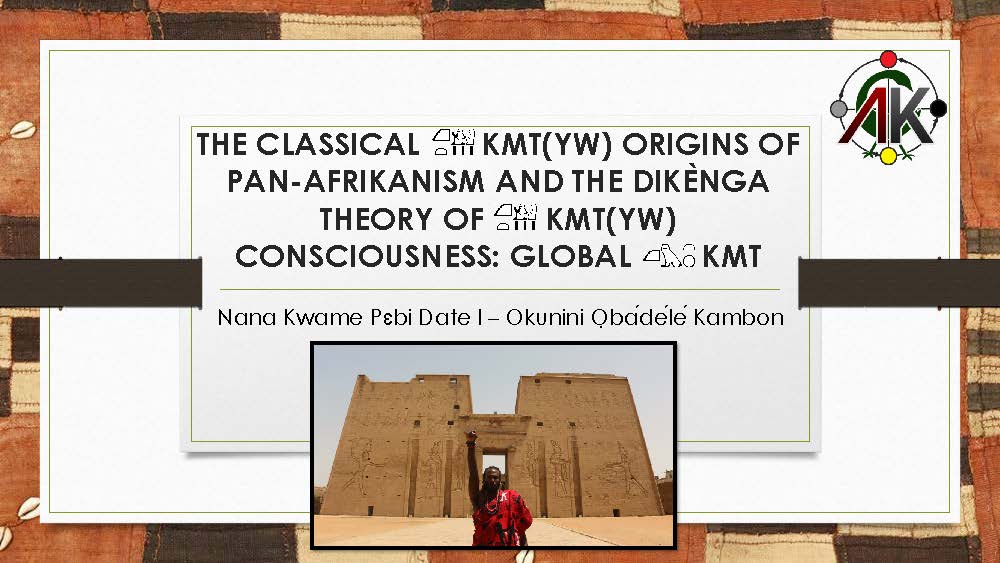
    Classical Kmt Pan-Afrikanism did not begin with enslavement. It did not begin as a reaction to whiteness. In fact, the unification of Kmt(yw) — Black people — stretches back thousands of years into antiquity. Most scholars treat Pan-Afrikanism as a modern political movement. However, Ɔbenfo Ọbádélé Bakari Kambon challenges that assumption with devastating scholarly precision. In this powerful 72-minute presentation spanning 97 slides, he traces the deep ancestral roots of Afrikan=Black power directly to the classical civilization of Kmt.

    Furthermore, Ɔbenfo Kambon dismantles the myth that Black identity emerged simply as a response to Bacon’s Rebellion or the rise of capitalism. Instead, he grounds Kmt(yw) identity in something far more ancient and enduring. Blackness, he demonstrates, encompasses genotype, phenotype, allegiance, culture, and politics. As a result, Black Pan-Afrikanism reveals itself as a timeless strategy of self-preservation. It is the ongoing project of Afrikan=Black people protecting and advancing their own survival across centuries and continents.

    The Dikènga Theory and Classical Kmt Pan-Afrikanism as a Living Framework

    In addition to tracing these ancient origins, Ɔbenfo Ọbádélé Bakari Kambon introduces the Dikènga Theory of Kmt(yw) Consciousness. This framework maps the cyclical nature of Afrikan=Black consciousness and liberation. Moreover, it connects the spiritual and political traditions of ancient Kmt directly to our present-day struggle for Abibifahodie. The Dikènga is not merely academic. It is a living tool that Afrikan people can use to understand where we are in our collective journey. Most importantly, it points clearly toward where we must go next.

    This lecture belongs in the home, the classroom, and every liberation study circle. Scholars, students, parents, and community builders will all find deep nourishment here. Abibitumi exists precisely to place this level of Afrikan-centered scholarship directly in our hands. Therefore, do not wait to engage this knowledge. Every minute of these 72 minutes builds the intellectual foundation that Abibifahodie demands. Watch it, study it, and share it with your community.

    Watch / Get it here: RBG100: Classical Kmt Origins of Pan-Afrikanism — Abibitumi

  • Why Afrikan Indigenous Languages Must Be Taught to Our Children

    Afrikan indigenous languages

    Afrikan indigenous languages are not relics of the past — they are living vessels of identity, power, and resistance. Language shapes how we think, how we see the world, and how we organize for liberation. Furthermore, when we lose our languages, we lose the intellectual architecture our ancestors built over millennia. This is precisely why Abibitumi continues to center language reclamation as a cornerstone of Abibifahodie.

    Ɔbenfo Kambon on Afrikan Indigenous Languages, Neologisms, and Development

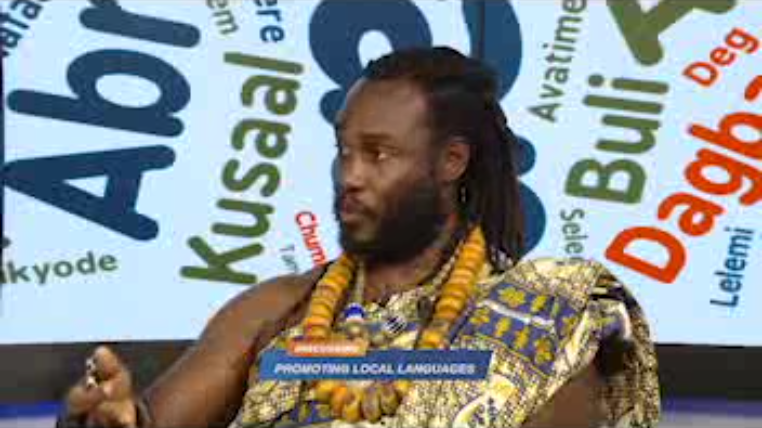
    In this powerful 51-minute presentation, originally aired on Mx24 GH TV, Ɔbenfo Ọbádélé Bakari Kambon speaks directly to the urgency of teaching our languages to our children. He breaks down what “language development” truly means for Afrikan people. In addition, he explores how neologisms — newly coined terms — allow our languages to grow, adapt, and serve modern Afrikan life. Most importantly, he demolishes every excuse we have been given for abandoning our tongues.

    Ɔbenfo Kambon does not speak in abstractions. He delivers grounded, actionable truth rooted in Pan-Afrikan scholarship and lived Afrikan experience. He draws on the legacy of the Kmtyw and connects ancient linguistic tradition to present-day community building. As a result, this lecture speaks powerfully to scholars, parents, students, and every Afrikan person committed to raising the next generation in full cultural dignity. However, you do not need a degree to receive what he is offering here — you simply need the willingness to reclaim what was always ours.

    The title of this lecture carries a deliberate, provocative strike through the word “local.” That single editorial choice says everything. Our languages are not merely local — they are indigenous, sovereign, and sacred. Therefore, every Afrikan family, school, and community organization must treat language transmission as a liberation priority. If you have been searching for the clarity and conviction to begin that journey, Ɔbenfo Kambon gives you everything you need in this one talk. Do not wait. Watch it, study it, and share it with your community.

    Watch / Get it here: PROMOTING INDIGENOUS LANGUAGES featuring Ɔbenfo Ọbádélé Kambon — $10.00