Tag: culture

  • Is Your Afrikan Spirituality Liberating You — Or Keeping You Enslaved?

    Is Your Afrikan Spirituality Liberating You — Or Keeping You Enslaved?

    Afrikan spirituality liberation

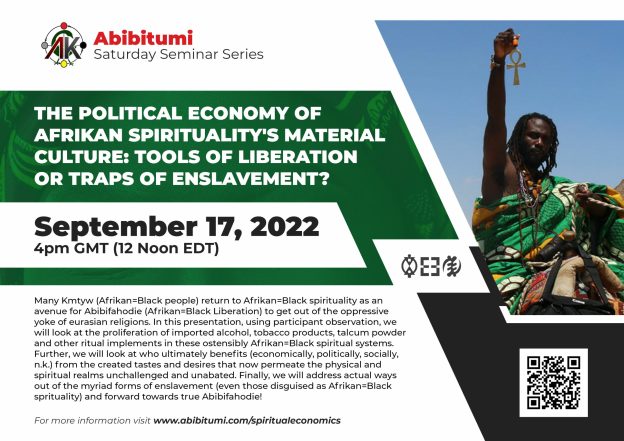
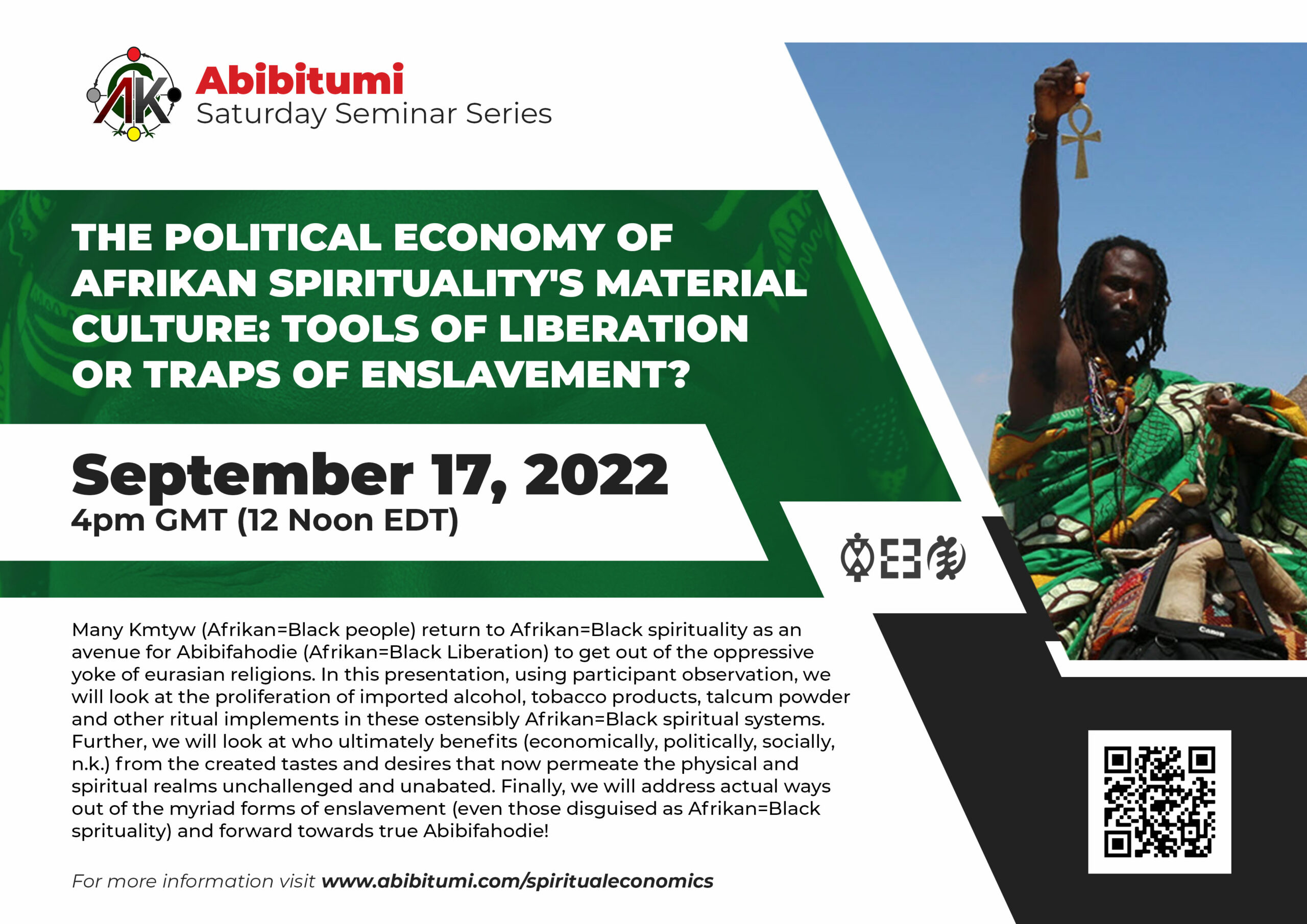
    Afrikan spirituality liberation calls many Kmtyw home — away from eurasian religions and back toward the sacred traditions of our ancestors. However, not everything labeled “Afrikan” actually serves Afrikan people. In fact, some of it serves our oppressors directly. This critical truth sits at the heart of one of Ɔbenfo Ọbádélé Bakari Kambon’s most important presentations available now through Abibitumi.

    In this powerful lecture, Ɔbenfo Kambon applies participant observation to examine what fills the altars and ritual spaces of ostensibly Afrikan spiritual systems. Furthermore, he identifies a troubling pattern: imported alcohol, tobacco, talcum powder, and other commodities dominate these sacred spaces. As a result, someone is profiting — and that someone is not us. Ɔbenfo asks the essential question directly: who ultimately benefits economically, politically, and socially from the tastes and desires now embedded in our spiritual practice?

    Unmasking the Political Economy Hidden Inside Afrikan Spirituality Liberation

    Most importantly, this lecture does not stop at critique. Ɔbenfo Kambon charts a clear and actionable path forward. He distinguishes between spiritual systems that genuinely advance Abibifahodie and those that quietly extend our enslavement under a different name. In addition, he equips Kmtyw with the analytical tools to see these distinctions clearly. Therefore, this is not simply an academic exercise — it is a roadmap for our collective liberation.

    This lecture is essential for scholars, community builders, students, and every Afrikan person seriously committed to Abibifahodie. Moreover, it pairs a full video recording with slides, giving you both the depth of Ɔbenfo’s analysis and the visual framework to study and share it. Abibitumi continues to deliver the knowledge our communities need — uncompromised and unapologetic. Watch it, study it, and act on it.

    🎥 Watch / Get it here: The Political Economy of Afrikan Spirituality’s Material Culture — $20.00

  • Who Programmed Your Desires? Understanding the Cultural War Against Afrikan People

    Who Programmed Your Desires? Understanding the Cultural War Against Afrikan People

    cultural warfare against Afrikan people

    Cultural warfare against Afrikan people is not accidental — it is engineered, deliberate, and ongoing. Nana Amos Wilson asked a piercing question: why does the Black man define freedom as doing what he wants, yet everything he wants enriches the European? That question cuts to the heart of our condition. Furthermore, it demands that we examine not just what we desire, but who designed those desires and why.

    Ɔbenfo Ọbádélé Bakari Kambon — world-renowned Pan-Afrikan linguist and architect of Abibitumi — addresses this question directly in this powerful recorded seminar. He guides us through the mechanics of social and cultural domination. Most importantly, he shows us how our tastes, interests, and values have been strategically implanted to serve European accumulation. As a result, understanding the enemy’s methods becomes the first act of liberation — Abibifahodie.

    Countering Cultural Warfare Against Afrikan People: Work Happening on the Ground

    This presentation does not stop at diagnosis. Ɔbenfo Kambon also highlights concrete, ground-level work being done to counter the assault on Kmtyw — Afrikan and Black people worldwide. In addition, the seminar spans nearly three hours of deep, uncompromising analysis backed by 39 slides. Recorded on April 3, 2021, this is not theory disconnected from life. However, it is rigorous enough to satisfy scholars and clear enough to awaken every Afrikan community builder, parent, and student.

    Abibitumi exists to arm our people with knowledge that serves our liberation — not our oppressors. This recording is exactly that kind of weapon. Therefore, if you are serious about understanding the forces arrayed against us and contributing to Afrikan survival, this seminar belongs in your study. Watch it. Study it. Share it with your community. Get it here: Watch / Get it here — $20.00.

  • How Afrikan People Can Combat Cultural Imperialism and Reclaim Our Intangible Heritage

    How Afrikan People Can Combat Cultural Imperialism and Reclaim Our Intangible Heritage

    combating cultural imperialism Afrikan

    Combating cultural imperialism Afrikan communities face daily begins with naming the enemy clearly. Cultural misorientation is not accidental. It is a deliberate, systematic project designed to sever Afrikan people from our ancestral worldview. Furthermore, when we allow aborɔfoɔ (eurasians) to define our reality, we surrender the very foundation of our liberation. As a result, Abibifoɔ must act with urgency and precision to reclaim what belongs to us.

    Ɔbenfo Ọbádélé Bakari Kambon — Pan-Afrikan linguist, scholar, and architect of Abibitumi — delivers this truth with unapologetic clarity. In this powerful recorded presentation, he conducts a rigorous case study of the 2019 UNESCO-ICM Open School. Most importantly, he exposes how terminological confusion weaponizes language against our people. He also reveals the danger of using the equal sign between concepts that are not equal. In addition, he demonstrates why Abibifoɔ must set our own agenda — grounded in Ma’at and our living ancestral traditions.

    Why Combating Cultural Imperialism Afrikan Scholars Must Prioritize This Analysis

    This presentation runs one hour and twenty minutes of dense, liberating scholarship. However, every minute earns its place. Ɔbenfo Kambon moves through each theme with surgical precision and ancestral grounding. He does not beg the system for recognition. Instead, he builds the intellectual architecture Afrikan people need to defend our intangible cultural heritage. Furthermore, this is not theory for theory’s sake — it is a direct tool for Abibifahodie, Black Liberation in practice. Students, scholars, parents, and community builders will all find urgent relevance here.

    Our intangible heritage — our languages, cosmologies, naming traditions, and ancestral knowledge systems — faces constant assault. Nevertheless, Abibitumi remains a fortress of Afrikan-centered education and resistance. This presentation stands as one of its sharpest weapons. Therefore, if you are serious about protecting Afrikan minds and building liberated communities, this lecture belongs in your study arsenal. Do not wait for permission to reclaim what is already yours. Watch it, study it, share it with your people.

    🎓 Watch / Get it here: Combating Cultural Imperialism & Misorientation — Video + Slides | $20.00

  • How Cultural Imperialism Hijacks Afrikan Martial Arts — And What We Must Do About It

    How Cultural Imperialism Hijacks Afrikan Martial Arts — And What We Must Do About It

    Afrikan martial arts cultural imperialism

    Afrikan martial arts cultural imperialism is not a theory — it is a living, documented assault on our intangible cultural heritage. Across the globe, Afrikan=Black movement traditions are being repackaged, renamed, and removed from their roots. Furthermore, institutions like UNESCO actively participate in this erasure, often with the full approval of a misoriented global system. This must be challenged directly, systematically, and unapologetically.

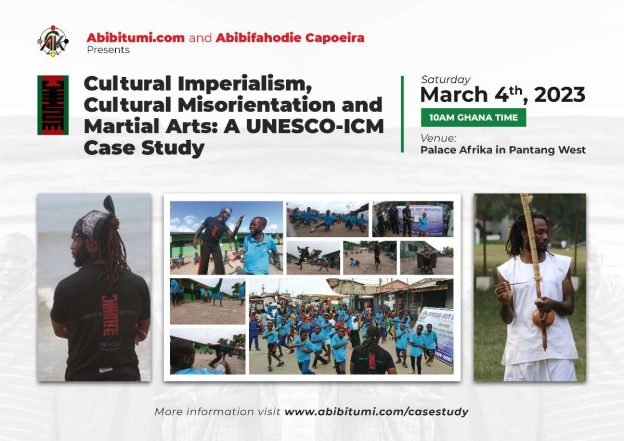
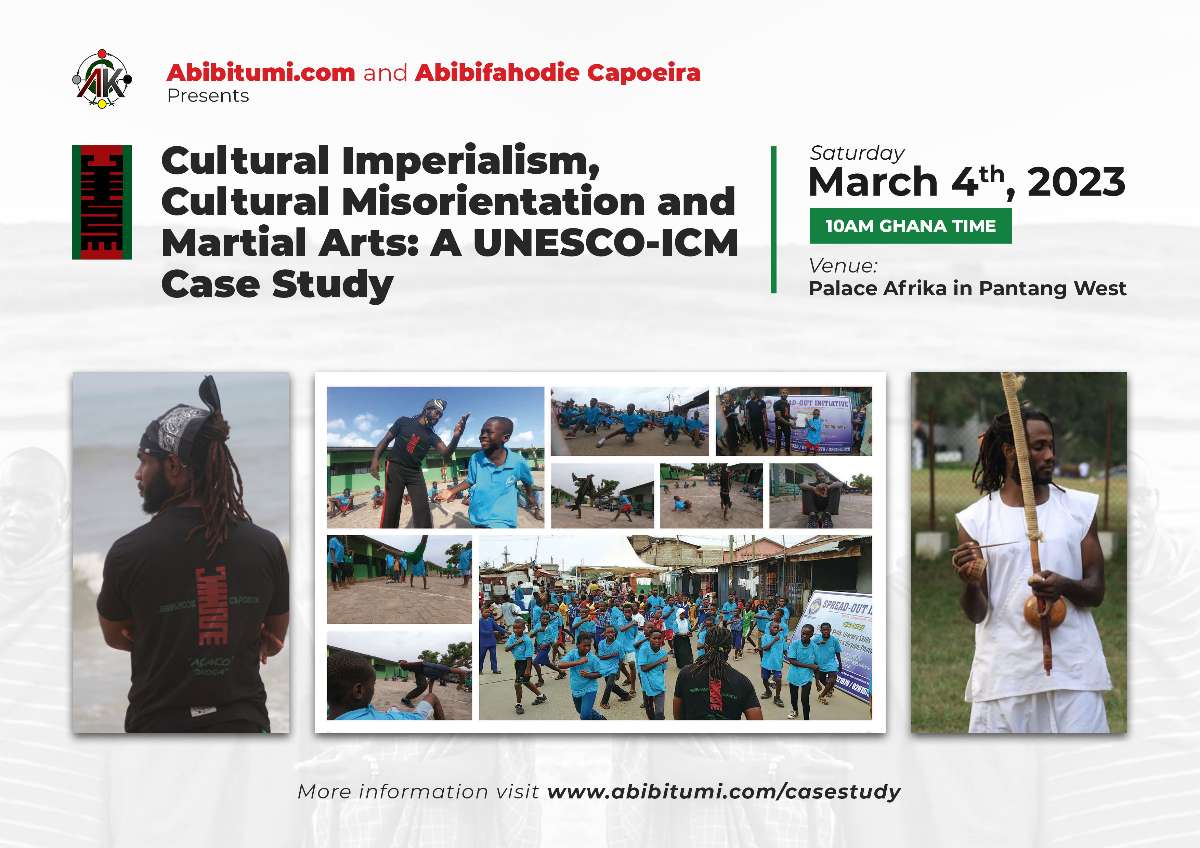
    Ɔbenfo Ọbádélé Kambon Breaks Down Afrikan Martial Arts, Cultural Imperialism, and the UNESCO-ICM Case

    In this essential lecture, Ɔbenfo Ọbádélé Bakari Kambon delivers a razor-sharp analysis of how cultural misorientation operates within martial arts spaces. Specifically, he uses Capoeira as a powerful case study. However, his framework extends far beyond one tradition. Most importantly, he centers Afrikan=Black people as the rightful custodians and drivers of our own cultural agenda. This talk is not passive observation — it is a call to action.

    Ɔbenfo Kambon grounds his analysis in real institutional examples and lived cultural realities. As a result, scholars, students, and community builders will walk away with sharper critical tools. In addition, this lecture serves as a direct prelude to Capoeira classes held at Palace Afrika every Saturday at 10AM. Therefore, this is both theory and practice working in full alignment. The community building dimension here is deliberate and powerful.

    Abibitumi exists precisely for moments like this. This lecture reminds us that Abibifahodie — Black Liberation — requires us to guard, reclaim, and transmit our cultural wealth with intention. Moreover, preserving our intangible heritage is an act of resistance. Every parent, educator, martial artist, and freedom fighter needs this knowledge. Consequently, this recording belongs in every Afrikan household and study circle. Do not sleep on this offering.

    Watch the full lecture and support the work of Abibitumi here: Get it here — Cultural Imperialism, Cultural Misorientation and Martial Arts: A UNESCO-ICM Case Study.

  • The Real Story of Black Liberation: Reclaiming Afrikan History Before 1619

    The Real Story of Black Liberation: Reclaiming Afrikan History Before 1619

    Afrikan history before 1619

    Afrikan history before 1619 is far richer, far more defiant, and far more liberating than the mainstream narrative ever acknowledges. Most people accept 1619 as the starting point of the Afrikan experience in the so-called Americas. However, that framing is a carefully constructed lie. In truth, Afrikan people were already resisting, rebelling, and building free communities on this soil nearly a century before that date.

    In 1526, enslaved Afrikans at San Miguel de Guadalupe — in what colonizers called Spanish Florida — launched a successful rebellion. They drove off the Spanish. They won their freedom. Furthermore, they became permanent settlers, establishing one of the first free Black communities in the western hemisphere. Similarly, throughout the 1500s and into the early 1600s, Afrikan people across the so-called new world emancipated themselves and built free republics. These were not footnotes. These were acts of sovereign power. In addition, the transatlantic trade itself began not in 1619 but in 1441 — a fact that exposes the 400-year framing as a deliberate misdirection.

    Ɔbenfo Kambon Breaks Down the Misorientation Rooted in Afrikan History Before 1619

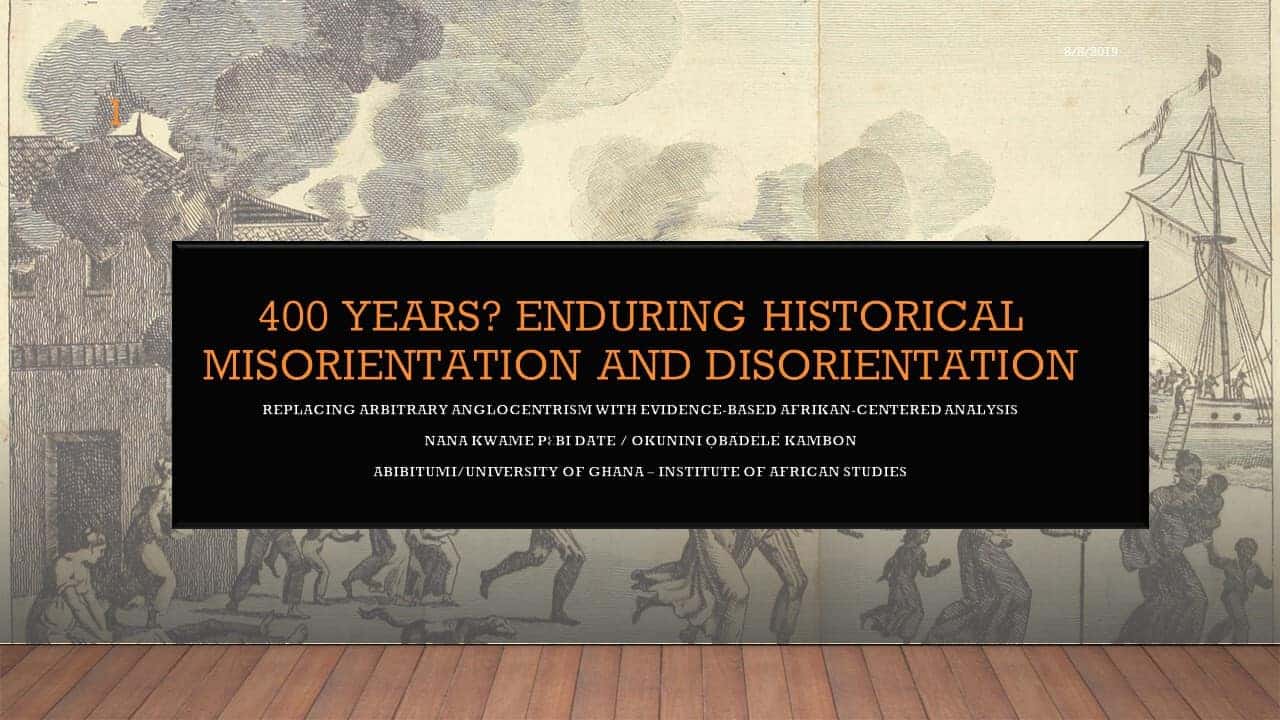
    Ɔbenfo Ọbádélé Bakari Kambon — Pan-Afrikan linguist, scholar, and architect of Abibitumi — delivers a masterful analysis of this historical misorientation in his lecture, 400 Years? Enduring Historical Misorientation and Disorientation and the Year of Return. He does not simply correct the record. Most importantly, he reveals why the misdirection exists and who benefits from it. He connects this distortion directly to the ongoing psychological and spiritual disorientation of Afrikan people worldwide. As a result, this lecture is not merely academic — it is a tool for Abibifahodie, Black Liberation itself.

    Abibitumi exists to provide Afrikan people with exactly this kind of weaponized knowledge. Therefore, this lecture belongs in every home, every classroom, every community circle committed to truth. Understanding our full history — unfiltered and unapologetic — is the foundation of liberation. Furthermore, when we know how far back our resistance goes, we reclaim our power. We reclaim our identity. We reclaim our future. Do not allow a single colonial date to define the magnitude of who we are and all that our ancestors accomplished. Watch this lecture. Study it. Share it.

    Watch / Get it here: 400 Years? Enduring Historical Misorientation and Disorientation and the Year of Return — $20.00