Tag: Akan

  • Sacred Afrikan Masks from Ghana: Gye Nyame, Cedar Wood & Cowries for Your Home or Office

    Sacred Afrikan Masks from Ghana: Gye Nyame, Cedar Wood & Cowries for Your Home or Office

    authentic Afrikan masks Ghana

    Authentic Afrikan masks from Ghana carry the living memory of our ancestors. This extraordinary pair—male and female—was handcrafted exclusively by traditional woodcarving guild members. Furthermore, Abibitumi’s in-house expert carver commissioned this one-of-a-kind piece with deep intentionality. It is not decoration. It is declaration.

    Each mask stands tall at 4.92 feet and spans 1.27 feet wide. Real copper, brass, and cowries are inlaid with fine, meticulous detail. Most importantly, the central theme is Gye Nyame—one of the most sacred Adinkra symbols of Akan cosmology. In Twi, it proclaims: AbÉ”deÉ› santann yi firi tete: obi nte aseÉ› a É”nim n’ahyÉ›aseÉ›. This means the procession of creation is eternal. No one witnessed its beginning. No one will witness its end—except the Divine. As a result, owning this piece means anchoring that truth in your space.

    Why Authentic Afrikan Masks from Ghana Belong in Your Sacred Space

    Ɔbenfo Ọbádélé Bakari Kambon—world-renowned Pan-Afrikan linguist and architect of Abibitumi—built this platform to reconnect Afrikan people with their cultural heritage. In addition, Abibitumi curates physical sacred objects that reinforce that reconnection daily. These masks do exactly that. Place them in your home, your office, or your community space. However, understand this: they are not mere art. They are portals to ancestral consciousness. Cedar wood grounds the spirit. Cowries call forth abundance. Copper and brass honor royalty.

    This pair is currently available at 50% off—now $2,000, reduced from $4,000. Therefore, now is the time to invest in your cultural foundation. Abibifahodie—Black Liberation—begins inside our homes and sacred spaces. Furthermore, every piece you bring into your environment either affirms your identity or erodes it. Choose affirmation. Choose Abibitumi. Secure your authentic Afrikan masks from Ghana today and let Gye Nyame watch over your space with power and permanence.

    Get yours here: Pair of Authentic Afrikan Masks from Ghana — Abibitumi

  • Akan and Yoruba Share the Same Roots — Here’s the Linguistic Proof

    Akan and Yoruba Share the Same Roots — Here’s the Linguistic Proof

    Akan Yoruba sound correspondences

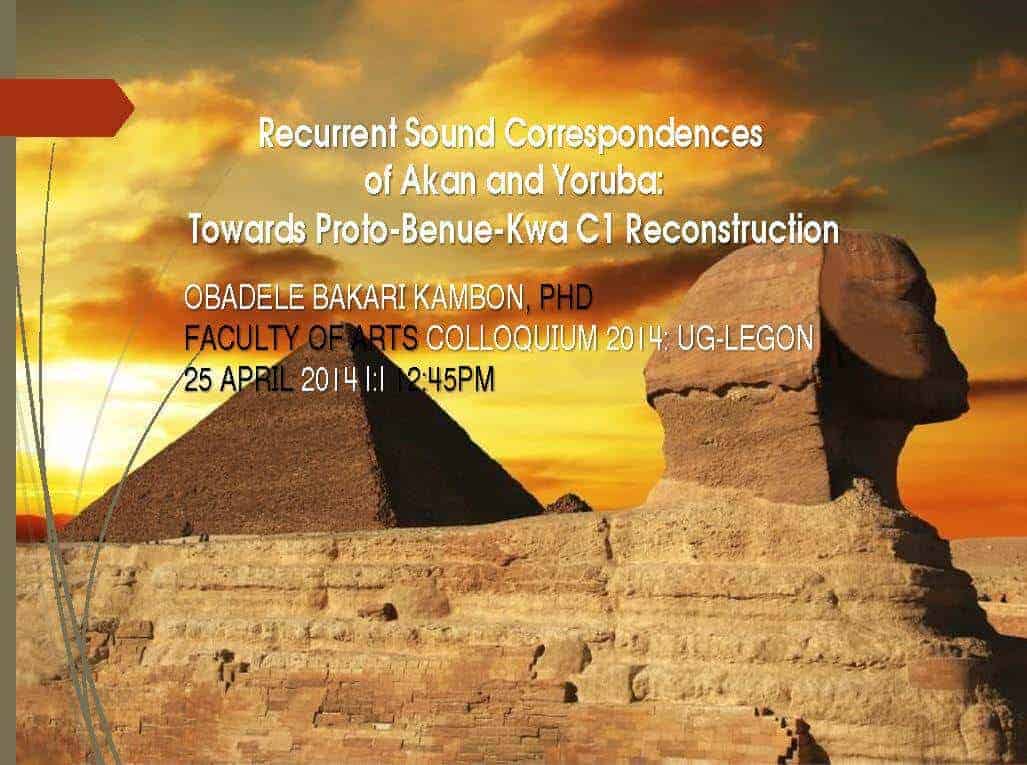
    Akan Yoruba sound correspondences are not coincidence — they are evidence of a shared Afrikan linguistic ancestry. Ɔbenfo Ọbádélé Bakari Kambon, world-renowned Pan-Afrikan linguist and architect of Abibitumi, brings this evidence into sharp focus. His groundbreaking presentation applies rigorous comparative linguistics to data drawn from the Swadesh Lists. As a result, Afrikan people gain a powerful, scholarly window into their own deep history.

    In this lecture, Ɔbenfo Kambon examines lexical cognates found in both Akan (Twi) and Yoruba. Furthermore, he applies implicational laws of sound change to reconstruct Proto-Benue-Kwa — the ancestral proto-language from which both languages descend. This work centers the initial consonant position, known as C1, as a key site of analysis. Most importantly, this is not abstract theory. This is Afrikan people reclaiming the record of their own linguistic and cultural continuity.

    Why Reconstructing Akan Yoruba Sound Correspondences Matters for Abibifahodie

    Language is power. Knowing how Afrikan languages connect across geography and time strengthens collective Afrikan identity. In addition, this research challenges Eurocentric frameworks that have long fragmented and misrepresented Afrikan linguistic heritage. Ɔbenfo Kambon’s methodology is precise, disciplined, and unapologetically centered on Afrikan people. His reconstruction of Proto-Benue-Kwa pushes comparative linguistics forward — and it does so on Afrikan terms. Scholars, students, and community builders alike will find this presentation both intellectually rigorous and deeply affirming.

    This video lecture includes the full presentation slides for deeper study and reference. However, this resource is not just for academics. Parents teaching their children Twi or Yoruba will find new meaning in the sounds they already speak. Community builders working toward Abibifahodie — Black Liberation — need exactly this kind of foundational knowledge. Abibitumi exists to make this scholarship accessible to all Afrikan people everywhere. Watch, study, and share this work widely.

    Watch / Get it here: Recurrent Sound Correspondences of Akan and Yoruba — Video + Presentation Slides | $20.00

  • What Akan Spelling Errors Reveal About How We Think in Our Language

    What Akan Spelling Errors Reveal About How We Think in Our Language

    Akan writing and language

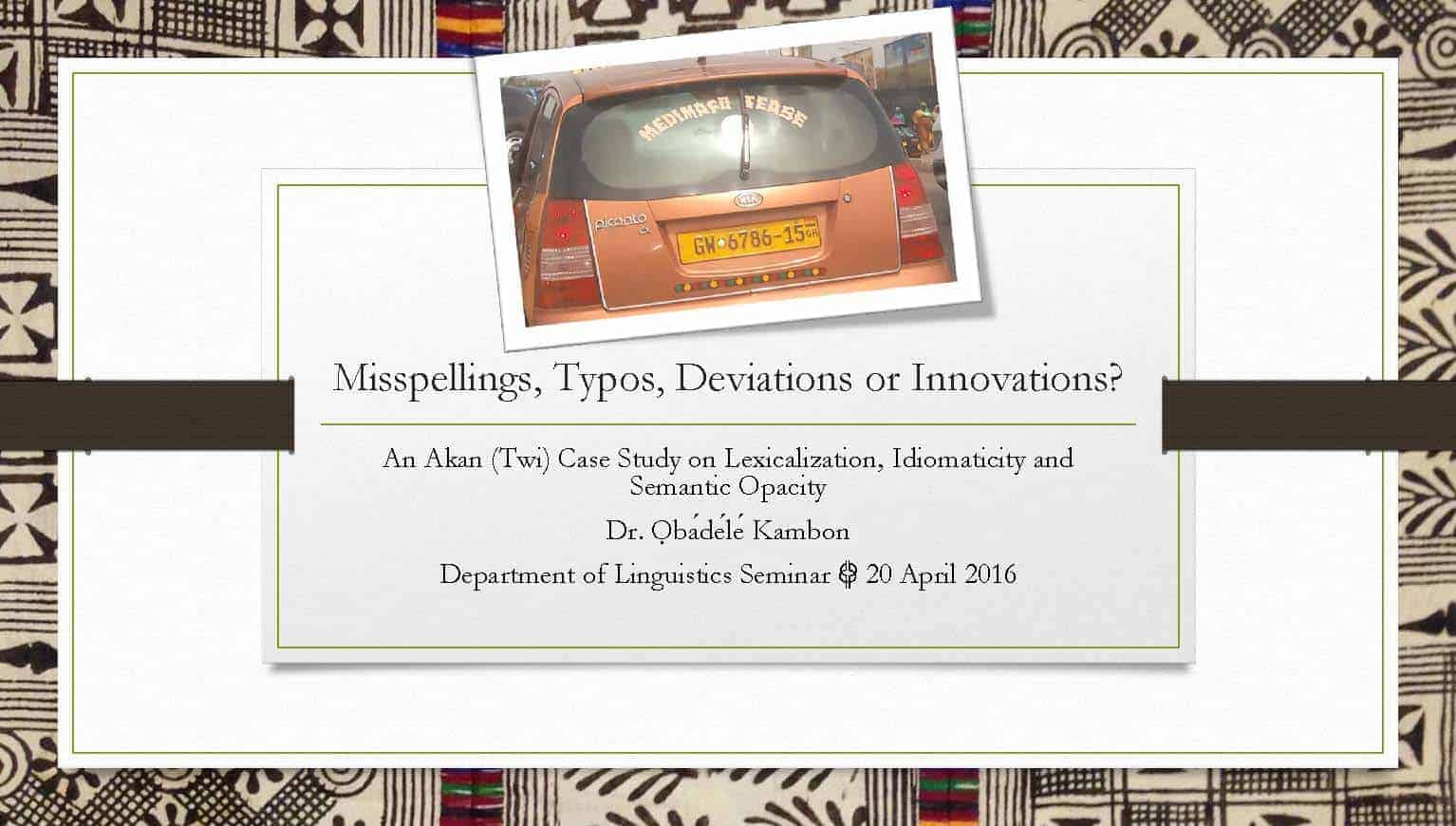
    Akan writing and language hold secrets that standard orthography alone cannot reveal. Most linguists dismiss irregular spellings as errors. However, Ɔbenfo Ọbádélé Bakari Kambon asks a deeper, more powerful question: what if those “errors” are actually windows into how Afrikan people think? This landmark 2016 seminar presentation challenges the very foundation of how we evaluate written language.

    Ɔbenfo Ọbádélé Kambon, architect of Abibitumi and world-renowned Pan-Afrikan linguist at the Department of Linguistics, delivered this 84-minute lecture with his signature scholarly precision. Furthermore, he grounds every argument in the lived reality of Akan (Twi) speakers and writers. Many of these speakers have never formally studied the standard orthography. As a result, their writing reveals something profound — not deficiency, but a living cognitive map of meaning-making. This is Abibifahodie in action: reclaiming the right to interpret our own linguistic reality.

    Why Akan Writing and Language Demand a Liberated Lens

    Ɔbenfo Kambon introduces three critical concepts to reframe this conversation: lexicalization, idiomaticity, and semantic opacity. Together, these tools expose how meaning solidifies inside a language over time. In addition, they explain why a “misspelling” may actually reflect deep semantic knowledge rather than ignorance. This is not a lecture about correcting our people. Most importantly, it is a lecture about understanding them — fully, brilliantly, and on our own terms. The 89-slide PowerPoint PDF accompanies the video and deepens every argument presented.

    This combo bundle — video and secured downloadable PDF — belongs in every Afrikan scholar’s library. Students, educators, community linguists, and parents raising children in Akan-speaking homes will all find transformative value here. Furthermore, this work strengthens our collective capacity to build Afrikan-centered language education. However, its significance extends beyond the classroom. It speaks directly to Abibifahodie — the liberation of Afrikan minds from frameworks that were never built for us. This is Abibitumi doing exactly what it was created to do: arming our people with knowledge that sets us free.

    Watch the lecture and download the full slide deck today. 👉 Get it here at Abibitumi.com — only $20.00.

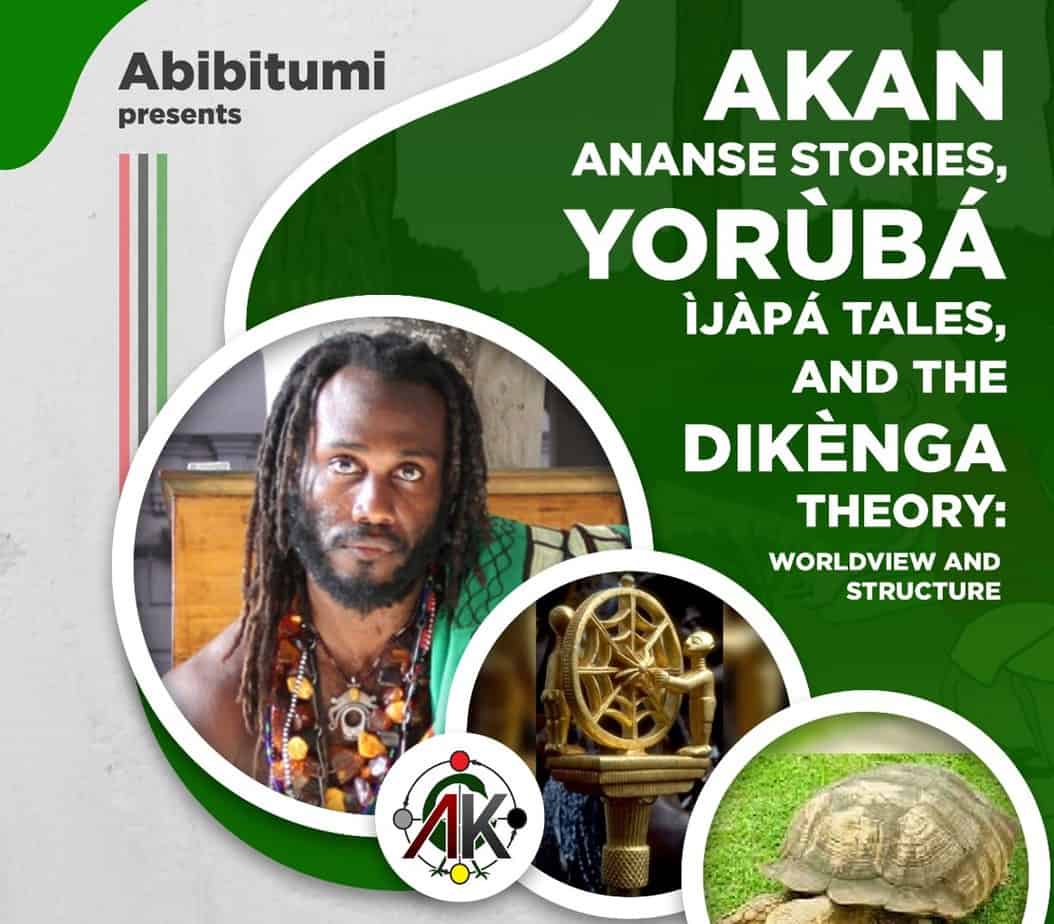
  • Akan Ananse, Yorùbá ÃŒjàpá, and the Dikènga Theory: Reclaiming Afrikan Literary Analysis

    Dikènga theory Afrikan stories

    The Dikènga theory Afrikan stories framework reveals something profound: our stories were never simply linear. They move in cycles. They mirror the cosmos. Ɔbenfo Ọbádélé Bakari Kambon — Pan-Afrikan linguist, scholar, and architect of Abibitumi — presents a revolutionary lecture applying the Bakôngo cosmogram to Akan Ananse and Yorùbá Ìjàpá tales. As a result, what emerges is a wholly Afrikan method of literary analysis. Furthermore, this approach dismantles the Eurocentric lens that has long distorted our understanding of Afrikan oral tradition.

    Fu-Kiau declared that “nothing exists that does not follow the steps of the cyclical Kongo cosmogram.” Ɔbenfo Kambon takes that declaration seriously. He tests it rigorously. In this study, he applies what he terms the Dikènga theory of literary analysis to these beloved story traditions. Consequently, concepts like “storylines” and “timelines” give way to something deeper — patterned, cyclical structures embedded in material, spatial, and temporal phenomena. Most importantly, this is not a borrowed framework. This is Afrikan cosmology doing exactly what it was designed to do.

    Why the Dikènga Theory Transforms How We Read Afrikan Stories

    Ananse and Ìjàpá are not merely trickster figures. They are cosmological agents. Their stories encode the worldview, structure, content, and function of Afrikan thought. However, Western literary theory has consistently failed to honor this depth. The Dikènga theory Afrikan stories approach corrects that failure completely. In addition, it gives scholars, students, parents, and community builders a powerful tool rooted in our own intellectual traditions. Abibifahodie demands that we stop interpreting ourselves through outside eyes. This lecture answers that demand directly and boldly.

    This lecture comes with both video and slides. Therefore, you can engage the material visually and analytically. Whether you are a seasoned scholar or a first-generation student of Pan-Afrikan thought, this resource meets you fully. Moreover, the Abibitumi platform exists precisely to deliver this level of scholarship directly to Afrikan people globally. This is liberation education. This is Kmtyw wisdom applied to Afrikan literary heritage. Do not miss it. Watch the full lecture and download the slides today.

    Watch / Get it here: VIDEO + SLIDES: Akan Ananse Stories, Yorùbá Ìjàpá Tales and the Dikènga Theory

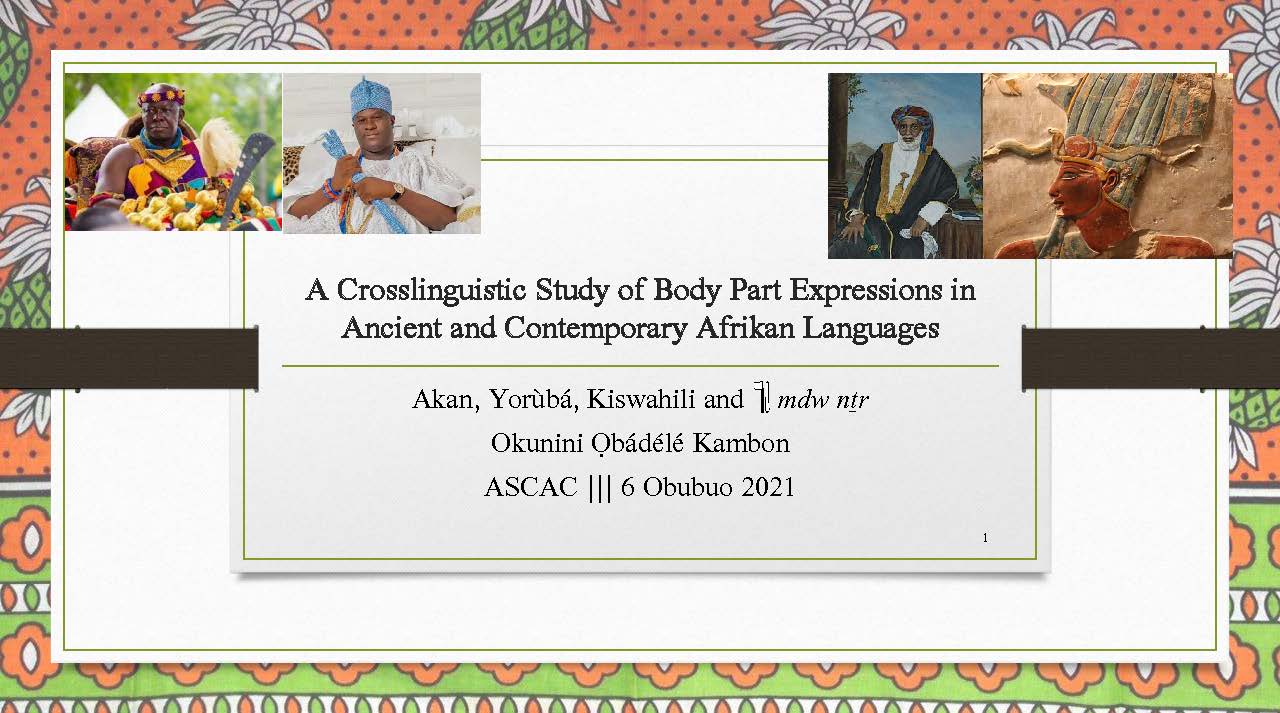
  • One Afrikan Mind: Body Part Expressions Across Akan, Yorùbá, Kiswahili, and Mdw Ntr

    Afrikan language body expressions

    Afrikan language body expressions carry a power that most academic institutions will never teach. They reveal something profound — that Afrikan people, across centuries and continents, share a continuous and unified worldview. In this landmark 2021 ASCAC presentation, Ɔbenfo Ọbádélé Bakari Kambon demonstrates exactly that. He traces linguistic patterns from Akan, Yorùbá, and Kiswahili all the way back to mdw nTr — the sacred language of the Kmtyw themselves.

    How Afrikan Language Body Expressions Reveal a Shared Continental Worldview

    Ɔbenfo Kambon examines how body parts function as conceptual anchors in four Afrikan languages. Furthermore, he shows that each language preserves a tight relationship between the physical body and its symbolic meaning. This is not coincidence. It is evidence of a shared philosophical inheritance — one that connects our ancestors in ancient Kmt to our communities in West and East Afrika today. In addition, the study draws from oral and written texts, grounding every insight in real, attested Afrikan expression.

    Most importantly, Ɔbenfo Kambon introduces a powerful analytical tool — the fundamental interrelation/fundamental alienation continuum. This framework measures how closely a language preserves its original, embodied Afrikan logic. As a result, we can chart which expressions stay rooted in Afrikan thought and which show signs of colonial disruption. This lens gives scholars, students, and community builders a sharper way to understand language as liberation — or as loss.

    This 33-minute lecture is essential viewing for anyone serious about Abibifahodie. It is precise, rigorous, and unapologetically Pan-Afrikan. Ɔbenfo Kambon does not simply compare languages — he reconstructs a worldview. He proves that the linguistic thread connecting Akan proverbs to Yorùbá idioms to Kiswahili expressions to mdw nTr hieroglyphics is unbroken. Abibitumi exists to bring exactly this kind of knowledge directly to Afrikan people everywhere. Watch this lecture, study it deeply, and share it widely.

    📺 Watch / Get it here: ASCAC 2021 — Body Part Expressions in Akan, Yorùbá, Kiswahili, and mdw nTr — Available now for $20.00.